How Movers Handle Parking in Four Common Situations
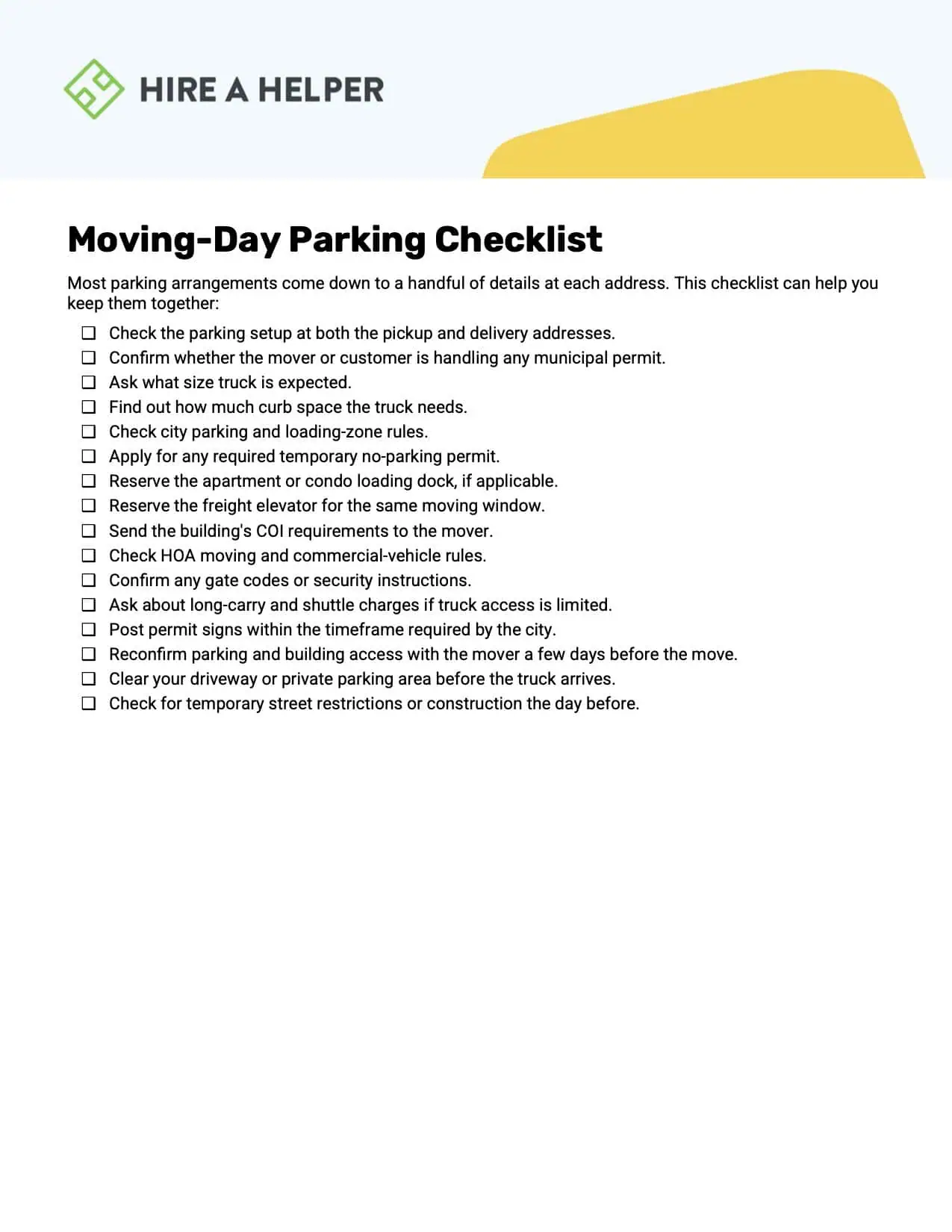
The easiest parking plan depends heavily on the property. A suburban driveway may need almost no paperwork, while an apartment on a busy city block could involve building management and a municipal permit.
Moving-Day Parking by Property Type| Situation | Usual Parking Spot | Who Usually Arranges Access |
|---|
| House with driveway | Driveway or legal curb space | Customer clears access; mover parks truck |
| Apartment or condo | Loading dock, designated loading area, or street | Customer and building management |
| Busy city street | Reserved curb space or legal loading zone | Customer, mover, or permit service, depending on local rules |
| HOA community | Driveway or HOA-approved area | Customer with HOA |
The pickup and delivery addresses may fall into completely different categories, so it's worth checking each one separately.
1. A House With a Driveway
A house with a usable driveway is usually the simplest parking situation because the crew may be able to park on private property without a city curb-space permit.
There can still be a few surprises. A driveway may be:
- Too short for the moving truck
- Too narrow for comfortable access
- Steep or uneven
- Soft enough that a heavy truck shouldn't use it
- Blocked by family vehicles
- Under low tree branches, power lines, or another overhead obstruction
- Difficult to enter from a narrow residential street
If you're not sure whether the truck will fit, you can mention the driveway during the estimate and ask what type or approximate size of vehicle the company expects to send.
Moving your own vehicles elsewhere the night before can leave the crew more options. If the truck may need some curb space too, a quick heads-up to nearby neighbors can also help keep the area open.
2. An Apartment or Condo Building
At an apartment or condo, building management usually controls where moving trucks can load and when the crew can use the property.
The building may have rules covering:
- Loading-dock reservations
- Designated moving hours or days
- Freight elevators
- Elevator padding
- Security access
- Moving deposits
- Certificates of Insurance
- Which entrance movers can use
A call or email to management early in the planning process can usually get you all the information on the policies that you need. If they have written moving instructions, you can pass those along to the moving company instead of trying to relay each detail yourself.
Some buildings have no private loading area at all. In that case, the truck may need to use public street parking even though the move is taking place in a private building.
That's where both sets of rules can apply: the building's requirements for getting inside and the city's requirements for parking outside.
Reserving the Loading Dock and Freight Elevator
If your building has both a freight elevator and a loading dock, they're often worth reserving together because the crew needs a continuous route from the truck to your unit.
A simple process might look like this:
- Ask management which moving dates and time windows are available.
- Reserve the loading dock and freight elevator for the same window.
- Find out how much time the building allows and whether another resident is booked before or after you.
- Ask who provides elevator padding or other common-area protection.
- Send the schedule and building instructions to the mover.
A confirmation the day before can be useful, especially in larger buildings where several staff members manage reservations.
Certificate of Insurance (COI) Requirements
A COI is a document showing that the moving company carries coverage for damage done to property or injury to their workers on the job. Some apartment and condo buildings require one before they'll let a moving crew use the property.
The building usually provides its exact requirements first. Those might include specific insurance limits, the property name and address, and other information it wants shown on the certificate.
You can then send those requirements to the moving company. The mover or its insurance representative provides the completed COI, which goes back to management for approval.
You can read a more detailed explanation of how moving COIs work if your building asks for one.
3. Street Parking on a Busy City Block
Without reserved space on a busy street, the driver may arrive to find every legal spot occupied. The next available option could be half a block away, around a corner, or somewhere the truck can't stay for the entire moving window.
That can create several problems at once. The crew has farther to carry everything, loading takes longer, parking restrictions may expire, and an illegally parked truck could receive a citation or be towed.
Each city handles this differently, so it’s important to check what the rules are in your area specifically. For example, Boston offers a moving-truck permit that reserves legal parking space, while Philadelphia uses a Temporary No Parking permit for moving trucks and containers.
4. An HOA-Governed Community
An HOA can have its own moving-truck rules even when the surrounding city would allow the vehicle to park there.
Private community rules might cover:
- Days and hours when moves are allowed
- Where the truck can park
- Gate access
- Truck size
- How long the vehicle can remain
- Advance notice
- Common-area protection
- Deposits or moving fees
The specific HOA rules can apply in addition to the city-wide ones. For example, a city may have no problem with a moving truck using a particular street, while the HOA restricts commercial vehicles to certain hours.
Getting a copy of the HOA's moving or parking rules early can make this much easier to sort out. Written instructions are especially useful because you can send the same information to the moving company.



 Melanie MorrisSep 1, 2026