How To Move With an Autistic Child

A parent helping an autistic child sort through familiar belongings in a packed-up bedroom during a move

Moving with any child requires planning and patience, but when you move with an autistic child, the entire process requires a different set of rules. For starters, you'll need to keep structure and predictability at the forefront of your preparation. Changes in routine, new environments, unfamiliar people, and sensory overload can all make moving unusually challenging, and this applies to both children and caregivers.

The good news is that, with the right support in place, moving doesn’t have to feel chaotic or overwhelming for you or your child. Specific planning and clear communication can help your kid feel safer and more in control every step of the way. This guide walks you through before, during, and after the move, with practical checklists and strategies you can start using today.


Last updated: Jan 30, 2026 12 min read

Key Takeaways

  • Routine and predictability are critical: when moving with an autistic child — sudden changes can trigger anxiety and meltdowns
  • Prepare your child weeks ahead: with visual schedules, social stories, photos of the new home, and walk-throughs if possible
  • Manage sensory needs during the move: noise-canceling headphones, a familiar comfort item, scheduled breaks, and a calm "safe space"
  • Use reinforcement and motivation strategies: small rewards for cooperation, choice boards, and consistent communication supports
  • Have a de-escalation plan ready: know your child's triggers, the early signs of overload, and quiet retreat options for moving day itself
Thomas O'Sullivan
Author

Thomas O'Sullivan

Thomas O'Sullivan is the Senior Manager of Service Operations at Porch Moving Group, where he oversees the post-booking customer experience for HireAHelper. His expertise is the part of a move most people never see — the logistics, coordination, and accountability that turn a booking into a finished move.

Thomas has spent six years in the moving and relocation industry, starting in corporate relocation and long-distance logistics before stepping into his current role. He's supported more than 130,000 moves across local labor, full-service, commercial, and long-distance work — experience he draws on to make sure HireAHelper content reflects how moves actually go.

Understanding How Moving Affects Autistic Children

Moving introduces new people, places, sights, smells, and noises, often all at once. For autistic children, this flood of change can feel unpredictable and overwhelming. A bit of context helps explain why.

“Children adjust better when the unknown becomes familiar. You can manage this by doing things like trying a video tour of the new house...[Or you] might even consider role-playing movers arriving or boxes stacked in rooms.”

Autism (autism spectrum disorder) is a developmental disability involving differences in the brain that may affect communication, social interaction, sensory processing, and flexible thinking. Every autistic child is different, and you’ll always know your child best, but many share common reactions to big transitions like moving.

Why Moves Can Be Challenging

Moves disrupt routine, predictability, and control, which are unfortunately the anchors that help many children with autism feel safe and calm. Even when a move is positive or exciting, the loss of familiar spaces and routines can still bring anxiety or confusion. It's not the move itself that causes distress as much as the rapid change in structure.

On top of that, moving often involves many unfamiliar adults and their belongings being packed into boxes or "disappearing." For a child who relies on visual order and sameness, this can feel upsetting or like their world is veering out of control. This behavior is often a stress response and not misbehavior, so try to respond with calm support.

Big changes during moves often include:

  • Different rooms, smells, and sounds
  • A new school and teachers
  • Different morning and bedtime routines
  • Unfamiliar people entering the home (movers, landlords, prospective buyers)
  • Abrupt schedule shifts

Common Emotional and Behavioral Reactions

Children with autism can often communicate stress through behavior rather than words. When internal anxiety rises, you may see more resistance or a sudden return to earlier habits you thought were long gone. This usually means the child is working very hard to cope with change and has less energy available for regulation and independence.

During the moving process, children with autism may experience:

  • Increased repetitive behaviors
  • Resistance to packing or leaving rooms
  • Difficulty sleeping or eating
  • Emotional outbursts or crying
  • Withdrawal or reduced communication
  • Regression in skills (toileting, independence)

Emotional outbursts or other behaviors are often a sign that the child has exceeded their coping capacity. It’s important to keep in mind that your child is saying they're overwhelmed, not willfully defying you. This signal tells you it's time to slow the environment down, add a little structure, and provide reassurance.

Recognizing Sensory and Communication Needs

Red-haired woman in glasses looks at a boy with crossed legs on a green chair.

Moves come with sensory input from every direction. New noises, bright lights, strong smells, different textures, and echoing empty rooms affect all children. Since a child with autism already processes sensory information differently, this extra stimulation can be exhausting. Some children seek more input to stay regulated, while others avoid input entirely. You likely already know which environment your child needs, so plan for headphones, quiet spaces, familiar blankets, and breaks well in advance.

Communication differences also play a big role. A child may understand more than they can express, or they may struggle to find the right words for big emotions like fear or sadness. When communication breaks down, behavior often replaces words. Adding visual schedules and simple scripts gives the child tools to express needs and anticipate what will happen next. This lowers anxiety for everyone.


Planning the Move With Your Autistic Child in Mind

It's important to limit the unpleasant surprises for your child as much as possible. Here are a few things to do before your move to allow your child sufficient time to adjust and adapt prior to the actual move.

Choosing the Right Time to Move

You’ll want to aim for dates that don't interfere with established routines. For example, if you have the flexibility, choose a move date that avoids the first or last week of school and skips major holidays. Tell your child early and return to the conversation often. Once they're aware, you can replace the big announcement with many small reminders, such as:

  • “We will be moving to a new house in 3 weeks.”
  • “Today we are packing books only.”
  • “Your bed will be the same. It will just be in a new room.”

Make sure to keep explanations short, consistent, and positive. Emphasize what isn’t changing, such as their favorite toys or family members. And talk up the benefits of their new home.

Researching Autism-Friendly Communities and Supports

Beyond schools, your new area will become your child’s world. That’s why it’s important to know what’s in your new neighborhood that could be helpful ahead of moving day. Look for:

  • Playgrounds with quiet zones
  • Clubs or sensory-friendly hours
  • Parent support groups
  • Pediatric therapy offices
  • Disability-friendly community centers

Many families find support through local Facebook groups or neurodiversity support forums. You might also look for special education parent groups and meetup groups for autistic children or siblings. Feeling socially anchored can make the emotional adjustment easier for both you and your child.

Evaluating Schools, Services, and Therapies in the New Area

Before moving, explore special education programs and autism support classrooms. Look into the availability of ABA/OT/PT/speech therapy and ask about any waitlist lengths. Also, make sure you notify the new school of any existing IEPs that will need to be transferred.

A few helpful avenues include:

Document everything and keep copies of your child's IEPs, evaluations, progress summaries, and all medical treatment, so the new school and support specialists can partner with you and help ease the transition for your child.

Coordinating With Your Child’s Current Care Team

A smiling woman looks at a child at a white desk with papers and pencils. Another woman is seated nearby.

Your current providers are allies during the transition. Let your child’s teachers, therapists, doctors, counselors, and case managers all know your move timeline. They often see your child in a different environment and have possibly established a different level of trust with your child. They can help with behavioral support strategies during disruption and maybe even make recommendations for providers in your new area.

Since a move likely means a new care team, request records transfers early so services don’t lapse. You can also suggest a video meeting with members of the current care team and the new team, if needed. Sometimes, that visual reassurance and meeting ahead of time can reduce anxiety.


Preparing Your Child Before the Move

Home Environment Transitions

A small bit of normalcy can provide positive results. Use this checklist to preserve familiarity wherever possible:

  • Maintain bedtime, meals, and hygiene routines.
  • Photograph your child's room and mirror it in the new space.
  • Pack your child’s room last and unpack it first.
  • Label drawers and shelves with pictures or words.
  • Pack special interest items in clear bins that they can see into.
  • Keep bedding and pillows the same for comfort and continuity.

School and Community Transitions

Changing schools and neighborhoods is a major transition for children. Follow this checklist to make the process as smooth and easy on you and your kids as possible:

  • Schedule a new school visit before the first day.
  • Request pictures of the teacher and classroom.
  • Drive new drop-off routes together.
  • Visit local playgrounds and grocery stores ahead of time.
  • Identify a quiet place in each setting your child can use if overwhelmed.

Creating Social Stories and Scripted Warnings

Social stories help children understand upcoming change before it happens. They answer things like: Where are we going? What will happen first/then? What am I expected to do? What if I feel scared?

A simple format might look like this:

  • First, we will pack our things.
  • Next, movers will put boxes on the truck.
  • Then, we will drive to our new house.
  • We will sleep in our same bed and use our same blankets.
  • It is okay to feel nervous. My family will keep me safe.

Countdown scripts are also important tools. They help autistic children anticipate an event, change, or transition happening in advance, and can sound like:

  • “In 10 minutes, packing will start."
  • "In 5 minutes, music headphones go on."
  • "In 1 minute, boxes will move into the hall.”

Transition songs and cues work for any age, even teenagers, but they work especially well for younger children. Keep everything brief, repetitive, and predictable. The key is previewing change, not surprising a child with it. You can accomplish this by creating:

  • Printed storybooks with photos of your real house
  • Index cards showing first/then steps
  • Tablet slideshow walk-throughs

Previews and Practice for the New Environment

Children adjust better when the unknown becomes familiar. You can manage this by doing things like trying a video tour of the new house. Or, when you arrive, walk through empty rooms before belongings get placed. Trace the path from your child's room to the bathroom, the kitchen, the front door, etc. Then, rehearse the bedtime routine.

You might even consider role-playing movers arriving or boxes stacked in rooms. And if it helps, make a point to say goodbye to the old house, allowing your child to have closure. This step normalizes what otherwise might feel startling or sad.


Managing Sensory and Emotional Needs During the Move

Moves can overload the senses fast. Plan ahead by identifying likely triggers. Watch for reactions to:

  • Loud tapping noises
  • Unfamiliar helpers
  • Echoing rooms
  • Bright overhead lighting
  • New smells

Create a calm space amid the chaos. Designate one room or corner as a low-demand zone, where nothing is packed yet. Keep the lighting soft, noise limited, and include preferred toys or blankets. Lead your child here anytime you notice they're getting overwhelmed.

To help reduce anxiety even further, prepare a sensory travel toolkit that you keep on hand, not in the moving truck. Be sure to include:

  • Noise-canceling headphones
  • Fidgets or chewable tools
  • Weighted lap pad or favorite blanket
  • Sunglasses or a hat
  • Snacks/water
  • Tablet or preferred music
  • Calming essential oil scent, if safe and appropriate

When your child has a clear way to cope, the risk of outbursts decreases significantly.


Reinforcement and Motivation Strategies

Transitions are easier when something positive follows effort. You already have the visual schedule for your child to follow, but you also need goals and rewards to create an incentive. Again, that short and positive framework is really effective.

You can try things like a token board, where your child gets a token for each completed activity and a reward after earning 3 tokens. You can also provide a reward after each task. For example, first, they pack their toys, then they watch a fun video.

You should also be sure to build breaks into the schedules and integrate the rewards simply, so expectations are clear. Keep praise simple and specific, and choose rewards aligned with your child's interests. If they're older, they might want a later bedtime pass or extra screen time.

Communication Supports Beyond Visuals

Visual supports are powerful, but many children also benefit from other communication tools. Augmentative and alternative communication (AAC) prompts give children clear ways to express needs when speech is hard. These might include speech devices, picture boards, or communication apps. Gesture cues, such as pointing or modeling, can make directions easier during stressful moments.

“Emotional outbursts or other behaviors are often a sign that the child has exceeded their coping capacity. It’s important to keep in mind that your child is saying they're overwhelmed, not willfully defying you.”

Priming techniques prepare your child right before a change occurs, such as saying, “In two minutes, we will start loading the car.” Supports should always match your child’s language level. Shorter phrases, fewer steps, and slower pacing usually help during transitions. The goal isn’t to talk more, but to communicate more clearly and in ways your child can process what you’re trying to say, even under stress.


Troubleshooting and De-Escalation Plans

Every good plan focuses on prevention first. Antecedent strategies include previewing tasks, lowering demands when your child becomes overwhelmed, and arranging quiet spaces before behavior escalates. When early stress signs appear, shifting to a familiar routine or calming activity often prevents a full meltdown.

If escalation happens, calming should be simple and consistent. You’re likely familiar with what works with your own child, but in general, many children benefit from deep pressure, quiet spaces, slow breathing with visual cues, or rhythmic movement. After your child recovers, avoid any lectures or “debriefing.” Instead, re-establish routine, acknowledge their effort in calming down, and adjust future plans using what you learned from the incident.


Practical Strategies for Packing and Moving Day

When moving day finally arrives, you want to have a game plan. Here are a few practical, parent-tested strategies to handle the hardest day of all:

  • Place special interests in dedicated, clearly marked bins.
  • Pack favorite snacks, pajamas, and comfort items in an essentials bag you keep with you, not in the moving truck.
  • Keep bedtime items immediately accessible.
  • Decide ahead of time whether your child should be present on moving day.
  • If needed, arrange a trusted caregiver or sitter.
  • Keep your child informed about who will be in the home (movers, relatives, neighbors).

For more tips, see our related guide on Moving With a Disability.

Settling Into the New Home and Community

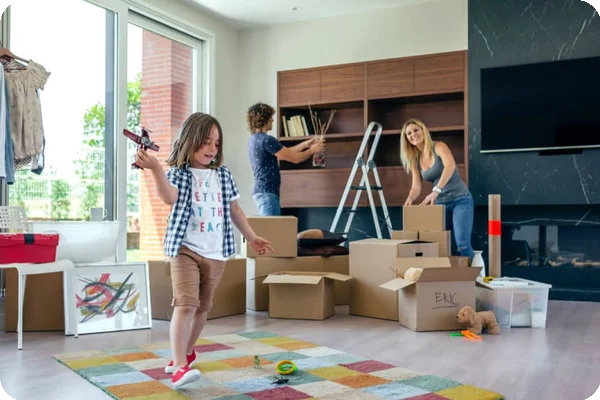
A family unpacks in their new home. A boy plays with a toy airplane, a man arranges items on a shelf, and a woman unpacks boxes.

The transition doesn’t end when the truck leaves. Start by setting up your child’s space first, mirroring the old room layout as much as possible and putting familiar bedding back in place. Restart daily routines the very first night to re-establish predictable actions and comfort.

After the basics feel familiar, slowly expand exposure to the community. Take short neighborhood walks, visit the new school or playground, and make brief trips to therapy offices or nearby stores. Continue reinforcing bravery and effort, and rebuild support networks by connecting with new teachers, therapists, and parent groups. Soon, your new home will become a safe, predictable baseline for your child.


Frequently Asked Questions

Recent Articles

A man and a woman are carrying moving boxes in a bright room, surrounded by packed boxes. A playful beagle jumps up on them.

Experts Share How to Make Your Pet Feel at Home After Moving

Kids & Pets

Moving already puts a strain on your human family members as you upheave your entire life. But your pets don't get the luxury of understanding the reasoning — they just suddenly find themselves hoisted into a new,... Read More

Image of a family moving with kids

The Ultimate Guide to Moving With Kids: Insights From Experts

Kids & Pets

Moving is a very physical experience — you’re literally relocating all your worldly goods from the place you currently call home to a new living space. But it’s also an emotional experience, especially for kids.... Read More

A parent holding a young child amid moving boxes in a partially packed living room

The Comprehensive Guide to Moving With a Child

Kids & Pets

Moving for adults is a generally stressful and draining event, but relocating with your child comes with even more physical and emotional needs. While we adults can tell ourselves, “just deal with it,” and have... Read More

Two children exploring a forested hiking trail with backpacks on a sunny day

Best Cities for Bringing Up Adventurous Kids

Kids & Pets

Hearken back to the days of yore when you were just a young ‘un. What was your favorite thing to do? Children love thrilling experiences and the novelty of trying something new—and it’s good for their brain. We... Read More

A happy dog and cat playing together in the living room of a new home

Help Your Pet Adjust to a New Home: Moving Tips for Dog and Cat Parents

Kids & Pets

Moving already takes a lot of effort and planning, but when you add pets into the picture, it can be even more stressful — for you and them. The boxes, the strangers, the unfamiliar scents and sounds — it’s a lot... Read More

a group of children all wearing colorful backpacks run happily towards their school building

A Parent's Guide to Moving Schools with Confidence

Kids & Pets

Whether prompted by a move or a carefully weighed decision to find a better fit for your child, transferring schools can bring a mix of uncertainty, hope, and a lot of questions.

How will my child adjust? Will they... Read More