2024-2025 Millennial Study: 1 in 10 Millennials Moved in 2024 but Which States and Cities Saw the Biggest Gains?

Understanding where millennials are moving provides key insights into economic shifts, housing demand, and workforce distribution. This report analyzes millennial migration trends across the U.S., identifying the states gaining and losing millennial movers.

Key Takeaways
- More than 7.7 million millennials moved in 2024: that’s 1 in every 10 millennials: in the U.S.
- Colorado led the nation with the highest millennial migration rate (+34.8%), while Connecticut saw the steepest decline (-64.8%).
- On the city level, Hanford, CA (+82%): and Baltimore, MD (+70%): drew the most millennials, while Amarillo, TX (-84%): and Sarasota, FL (-74%): saw the biggest drop-offs.
- The top drivers of millennial moves were seeking new or better housing (16.8%): and job opportunities (12.6%).
- High-income millennials: earning $120,000 or more most commonly moved to Maryland, North Carolina, and New York, respectively
Melanie Morris
Melanie Morris is an editor, writer, and one of the sharpest moving experts at HireAHelper. Seven years spent answering readers' toughest questions and demystifying a process most people dread has made her an authority on what movers actually need to know — and how to explain it without the jargon. Her own relocations around the Southwest and up and down the West Coast give her the firsthand experience to back it up. Whether you're crossing the country or just moving down the block, Melanie makes sure the advice you get is accurate, trustworthy, and easy to act on.
Millennial Magnets: Which States Are the Most and Least Attractive?
Some states attract millennials at higher or lower rates than the general population To measure this, we compare the percentage of millennials who moved to the state to the percentage of all U.S. movers relocating to the same area. The difference is expressed as a percent change to highlight how millennial migration trends differ from overall migration patterns.
Millennials Move to Colorado at the Highest Rate Compared to Other Generations
This migration trend reflects economic and lifestyle shifts among millennials. Many of the top states attracting millennials offer strong job markets, such as Maryland and Colorado, which ranked 2nd and 7th respectively for job growth last year. Conversely, states seeing lower millennial migration often face high housing costs, and fewer job opportunities, such as Iowa and Indiana which ranked 49th and 50th for job growth.
Top States for High- and Low-Income Millennials
High-income millennials seem to be concentrating heavily in certain coastal and high-opportunity states. Maryland, North Carolina, New York, Washington, and California all stand out, with Maryland seeing the sharpest increase; high-income millennials are moving there at a rate 138% higher than the general population. Similarly, North Carolina (+113%) and New York (+111%) reflect a pull toward major job hubs and lifestyle centers that combine economic opportunity with cultural appeal. These states also tend to be strong in tech, finance, or government-related employment, which aligns with the income profile of these movers.
This table compares where millennials of different income levels are moving at higher rates than the general population. For this analysis, low-income is defined as under $60,000, middle-income as $60,000–$120,000, and high-income as above $120,000.
While some regions are attracting high-income millennials, many others are losing them at steep rates. The decline is particularly visible in Southern and Midwestern states like Alabama, West Virginia, Tennessee, and Kentucky, all of which show 100% or nearly 100% lower migration rates compared to the general population. This suggests a widening gap: high-income millennials are leaving behind lower-cost but slower-growth areas in favor of high-cost but opportunity-rich states.
There’s also a small group of states with mixed performance. For instance, Nebraska and Pennsylvania are not usually seen as top destinations for millennials, yet both are attracting high-income millennials at double-digit rates above the general population. Meanwhile, states like Florida and Georgia — historically strong draws for relocations — are actually underperforming with this group, showing declines of around 50–60%. Taken together, the data shows that high-income millennials are not simply chasing affordability, but are clustering where career growth, amenities, and urban networks are strongest, even if it means higher living costs.
State-by-State Breakdown of Millennial Migration Trends
The table below offers a state-by-state analysis of millennial migration, showcasing where millennials are moving compared to the general U.S. population.
Top Metro Areas Millennials Are Moving to and Away From
The chart below shows the top metro areas where millennials moved, ranked by the percentage of the total population of millennials who moved.
New York City Tops the List as the Most Popular Metro for Millennials
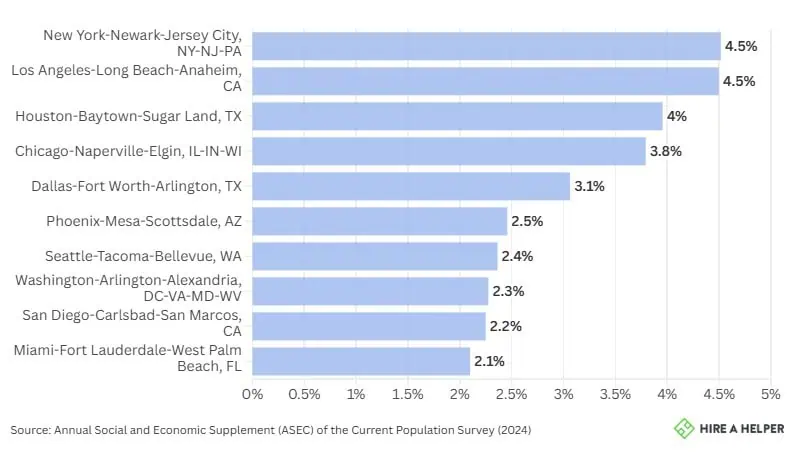
The largest metropolitan areas, such as New York City and Los Angeles continue to attract the most millennials, likely due to their strong job markets and diverse economic opportunities. However, more affordable metros like Houston and Phoenix also rank highly, signaling a shift toward more affordable yet still dynamic urban centers.
Much like states, there are certain metro areas that see millennials moving to and from there in rates higher/lower than the general population. The graph below highlights the top 20 metro areas in that category. These cities have a disproportionately high or low share of millennial movers compared to broader migration trends, offering insights into shifting urban preferences.
Millennials Move to Hanford-Corcoran, CA at the Highest Rate Compared to Other Generations, While Amarillo, TX Comes in Last
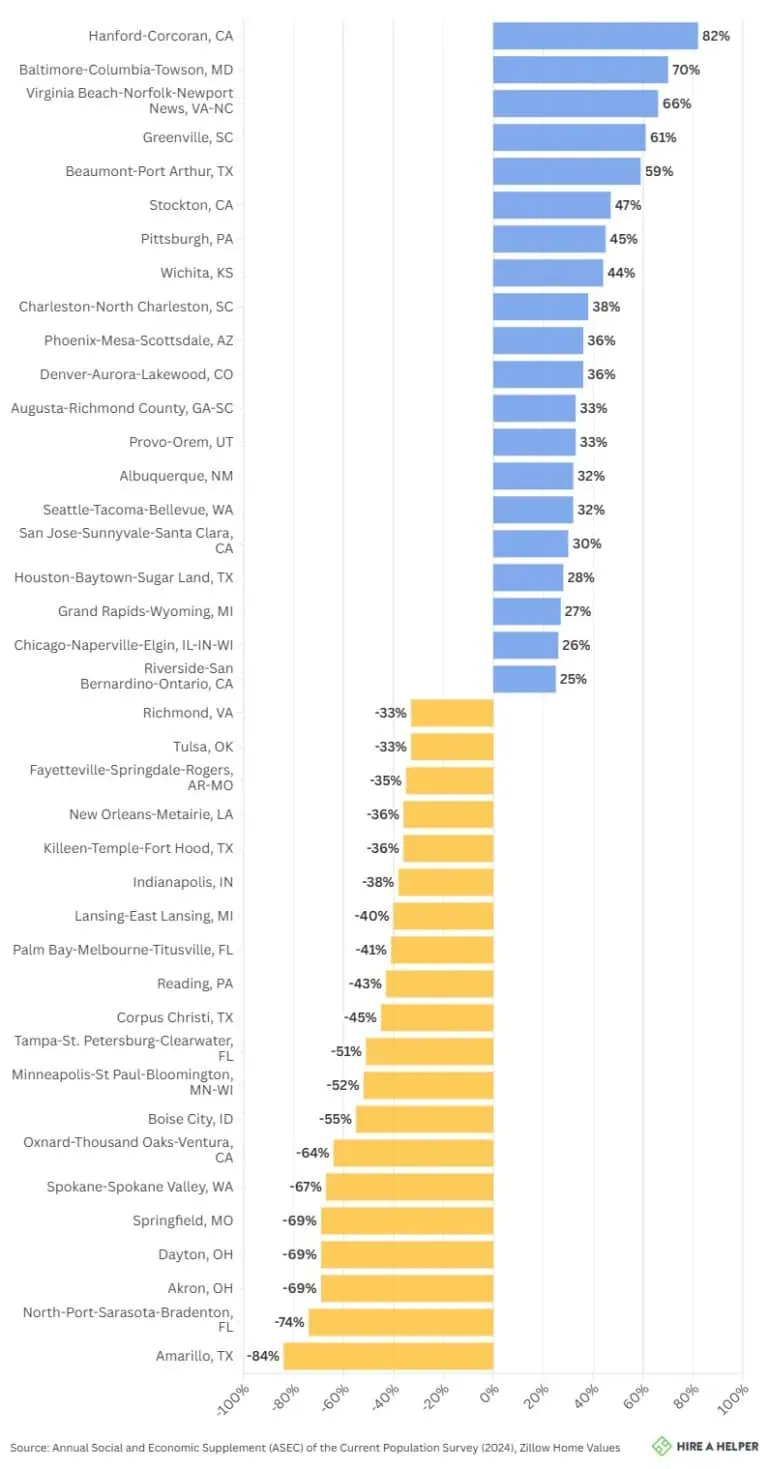
Metro areas with higher millennial migration rates are likely attractive to the cohort because of a mix of strong job markets, affordable housing, and desirable lifestyle factors. Cities such as Hanford, Virginia Beach, and Greenville have become millennial magnets, signaling shifts toward urban centers that offer both job opportunities and outdoor lifestyles.
How Housing Costs Factor Into Millennial Moves
Housing prices are a key factor influencing relocation trends. The table below breaks down millennial migration rates across major U.S. metro areas and how they compare to average home values.
The average U.S. home price is $357,138, yet many of the metros attracting the most millennials have home values below or near this threshold—for example, Baltimore ($182,997) and Wichita ($194,372).
In contrast, cities where millennial migration is lower, such as Oxnard ($760,739) and Salinas ($738,586), have home prices well above the national average. While some expensive metros like Seattle ($871,963) and San Jose ($1.5M) continue to draw millennials, it’s likely due to strong job markets. High-cost areas with fewer economic opportunities appear to be losing younger residents.
Why Are Millennials Moving? Better Housing and Job Changes Lead the List
Understanding why millennials are moving is just as important as knowing where they are relocating. The top reasons for millennial migration highlight a mix of economic, housing, and lifestyle factors.
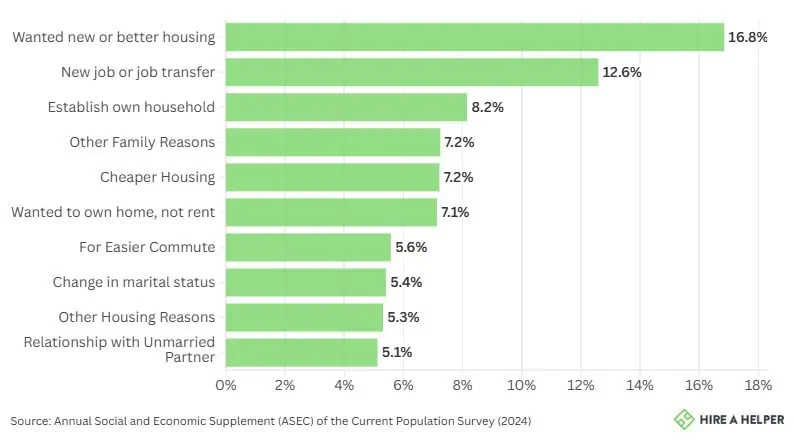
The data suggests that housing considerations are a major factor in millennial migration, alongside career opportunities. While job changes account for a significant share of moves (12.6%), the leading reason millennials relocated was the desire for new or better housing (16.8%), indicating that affordability and homeownership goals are key motivators. With rising home prices and cost-of-living concerns, many younger adults are moving to areas where they can secure better housing options or transition from renting to owning. This highlights the strong influence of both economic and lifestyle factors in shaping millennial migration patterns.
Sources and Methodology
All data on moves, their origins, destinations, and reasons behind them was taken from the U.S. Census Bureau’s Current Population Survey and its Annual Social and Economic Supplements, as available via IPUMS. All estimates and percentages are based on moves within the United States.
Home price data was collected from Zillow home values, using February 2025 and February 2022 data.
For this study, we adapted the definition of generations from Beresford Research which defined millennials as ages 28 – 43.
To measure whether millennials are migrating at higher or lower rates than the general population, we calculated the percent change between the percentage of millennials moving to each state in 2024 and the percentage of all U.S. movers relocating to that state.
For metro areas, only areas that accounted for 0.25% or more of all US moves in 2024 were included.
Latest Research

2025 Charlotte Moving Report
If it feels like everyone’s moving to Charlotte these days, you’re not imagining it! The Queen City is one of the fastest-growing places in North Carolina and the entire Southeast. According to our 2025 North Carolina Migration Report, 147 people move to Charlotte every day, part of a larger trend that has made North Carolina a top-five destination for movers nationwide. It’s drawing talent from across the state and beyond, reshaping how North Carolina grows and cementing its role as one of the country’s most dynamic cities.
We created this report to show what’s fueling that growth, who’s coming here, and what it means for people who already call Charlotte home.

The Future of Homeownership 2026
In 2026, the American Dream is facing a reality check. The median U.S. home price has climbed to $390,300 and is projected to reach $527,525 by 2031 - a 35.1% increase in just five years. But incomes aren't keeping up, despite growing minimum wages. Across the country, the gap between what people earn and what it takes to buy a home is widening fast, pushing homeownership further out of reach for millions of Americans.
This is a nationwide affordability crisis with sharp regional divides. In some states, buying a home still aligns with what the average household earns. In others, even an income of $100,000 falls short.
Using median home prices, household incomes, and five-year projections, this report reveals where Americans can still afford to buy today, where affordability is deteriorating fastest, and which markets may become realistic, or completely out of reach, by 2031.

2023 Study: 3 Million Moves Driven by Extreme Weather Events Last Year
In this study, HireAHelper takes a close look at moves forced by natural disasters in the United States.
Using the most recent data from the Census Bureau’s large-scale Household Pulse Survey and Current Population Survey, we focused on the number of disaster-forced moves over time, their typical destinations, as well as the types of disasters forcing most Americans out of their homes.

Study: How Much Does Moving Cost in 2023?
Driven by record inflation and rising fuel and vehicle costs, U.S. moving costs reached an all-time high in 2022. The average cost that year was $410—peaking at $454 in August—representing a 7% increase from 2021.
Prices have not yet given way; data from the first five months of 2023 shows an average moving cost of $399, which is 4% higher than the same period last year. It remains uncertain whether these costs will stay elevated or decline, which states will experience the sharpest price hikes, and if any areas will become cheaper.

2023 Study: Corporate Relocation at Highest Rate Since 2017
Whether to cut costs, gain a more beneficial tax rate, or be closer to a target market, about 9% of corporations in the United States moved their headquarters within the past fiscal year — the highest percentage since 2016-17, according to Securities and Exchange Commission (SEC) filings.
States like New York and cities like Seattle are seeing corporate headquarters move away, while smaller cities outside large urban centers are becoming new homes to big companies in tech and pharmaceuticals. Our study breaks down where companies are moving to, which states and cities they’re leaving behind, and whether workers are on board with following their employer to their new HQ location.

2023 Study: Where, How and Why Are Americans Moving This Year?
Every year, millions of Americans move, and over half (52%) of those moves take place during what we in the moving business call “moving season” — otherwise known as the summer months of May through August.
So what does the moving season hold for us this year? To get a sense of how many Americans intend to move, when they’re going to move, and what drives their moving decisions, HireAHelper conducted a nationally representative survey of 2,000 adults in the U.S. earlier this month.