The Hidden Health Toll of Moving

In this report, the moving experts at HireAHelper uncover the hidden health costs behind every relocation, from joint pain and burnout to anxiety, insomnia, and even trauma-level stress. Based on a survey of over 1,000 Americans, we reveal exactly why people find moving so stressful as well as the health effects they’ve experienced along the way.

Key Takeaways
- Over half (55%) of people rate moving as highly stressful, scoring it 7 or above on a 10-point scale, and around 10% describe it as traumatic.
- Finances are the top stressor of moving, cited by 52% of people, followed by the stress put on household members (41%) and logistical changes (38%).
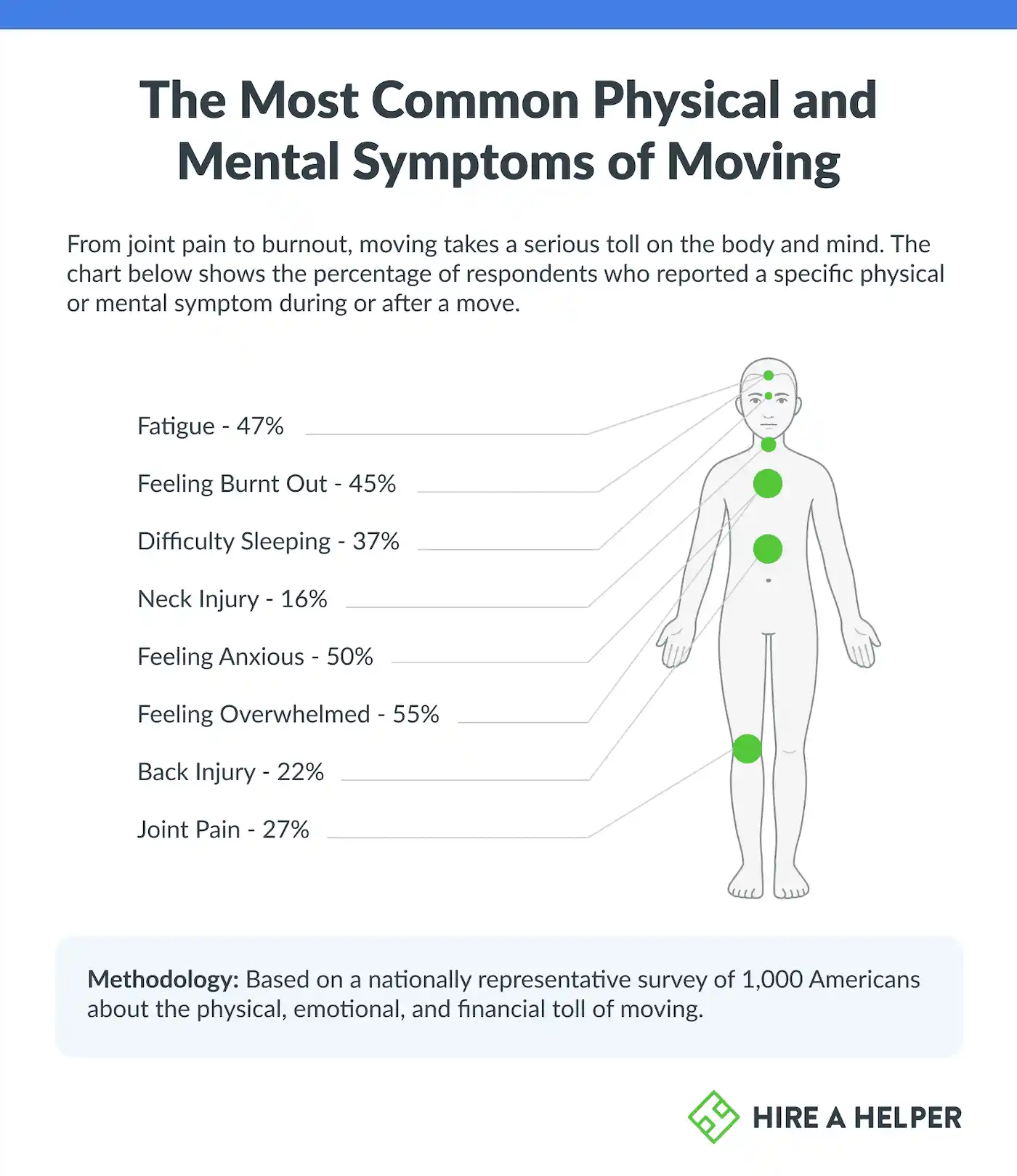
- Nearly 1 in 4 Americans injure themselves during a move, with 27% reporting joint pain, 22% back injury, and 16% neck injury.
- 55% of people feel overwhelmed by the moving process, while nearly half report anxiety (50%), fatigue (47%), or burnout (45%).
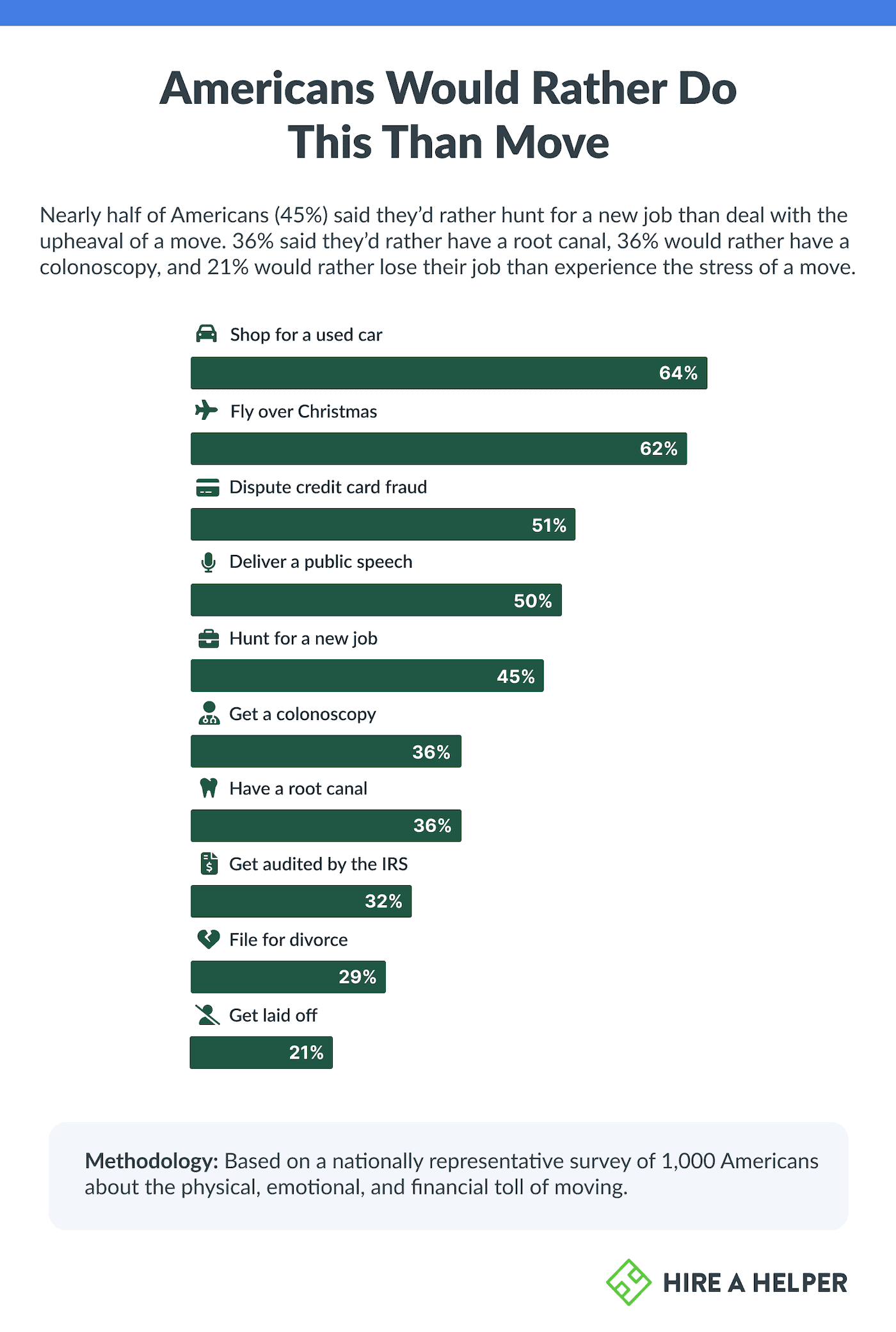
- 29% of people would rather get a divorce than move again, with 36% preferring a colonoscopy, and 21% preferring to lose their job.
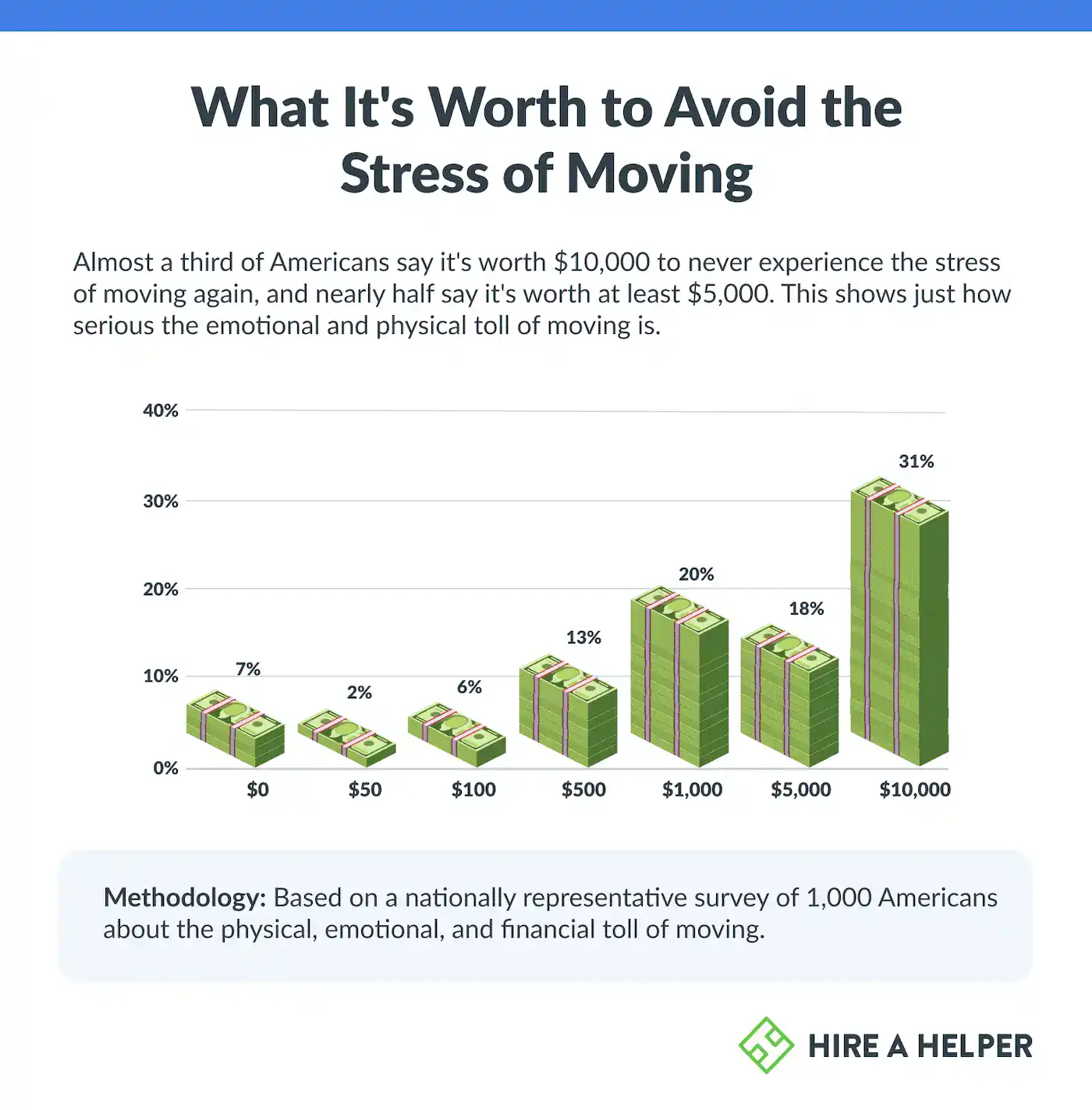
- A third of Americans say avoiding the stress of moving is worth $10,000, and nearly half (49%) say it’s worth at least $5,000.
Daniel Cobb
Daniel Cobb is the senior editor at HireAHelper and a self-proclaimed professional DIY mover. Having packed, loaded, and hauled his way through more than 20 moves — including a white-knuckle haul from Washington State to North Carolina — he knows exactly where do-it-yourself moves go sideways, and why professional help is so often worth it. Daniel pairs nearly a decade of writing and editing experience with all those hard-won miles, pressure-testing every guide he reviews so the advice is accurate, practical, and battle-tested. His mission is simple: make moving easier, and help you skip the mistakes he's already made for you.
At HireAHelper, we believe it’s time to stop ignoring the real health toll of moving. In the U.S., meaningful relocation support is treated like a luxury, offered mainly as a perk to those whose employers cover it – while millions navigate the stress alone. This gap isn’t just inconvenient, it’s a public health issue. By bringing awareness to the impact of moving stress and providing access to affordable assistance, we aim to improve the lives of millions across the nation.
Moving Is More Than Stressful, It’s Traumatic for 1 in 10 People
Moving is often listed alongside divorce and job loss as one of life’s most stressful events, but our new data shows that for many Americans, it goes far beyond stress. It's traumatic.
The Holmes-Rahe Life Stress Inventory is a psychological tool created to measure the impact of life events on stress levels and potential health outcomes. The closest category to moving is “major change in living condition,” which is scored at just 25 out of 100. However, our study suggests the emotional toll of moving may be significantly underestimated.
In our survey, more than half (55%) of people rated the stress of moving as a 7 or higher on a 10-point scale. 1 in 10 Americans described the experience as “crisis-level” or traumatic, language more commonly associated with medical emergencies or life-altering events.
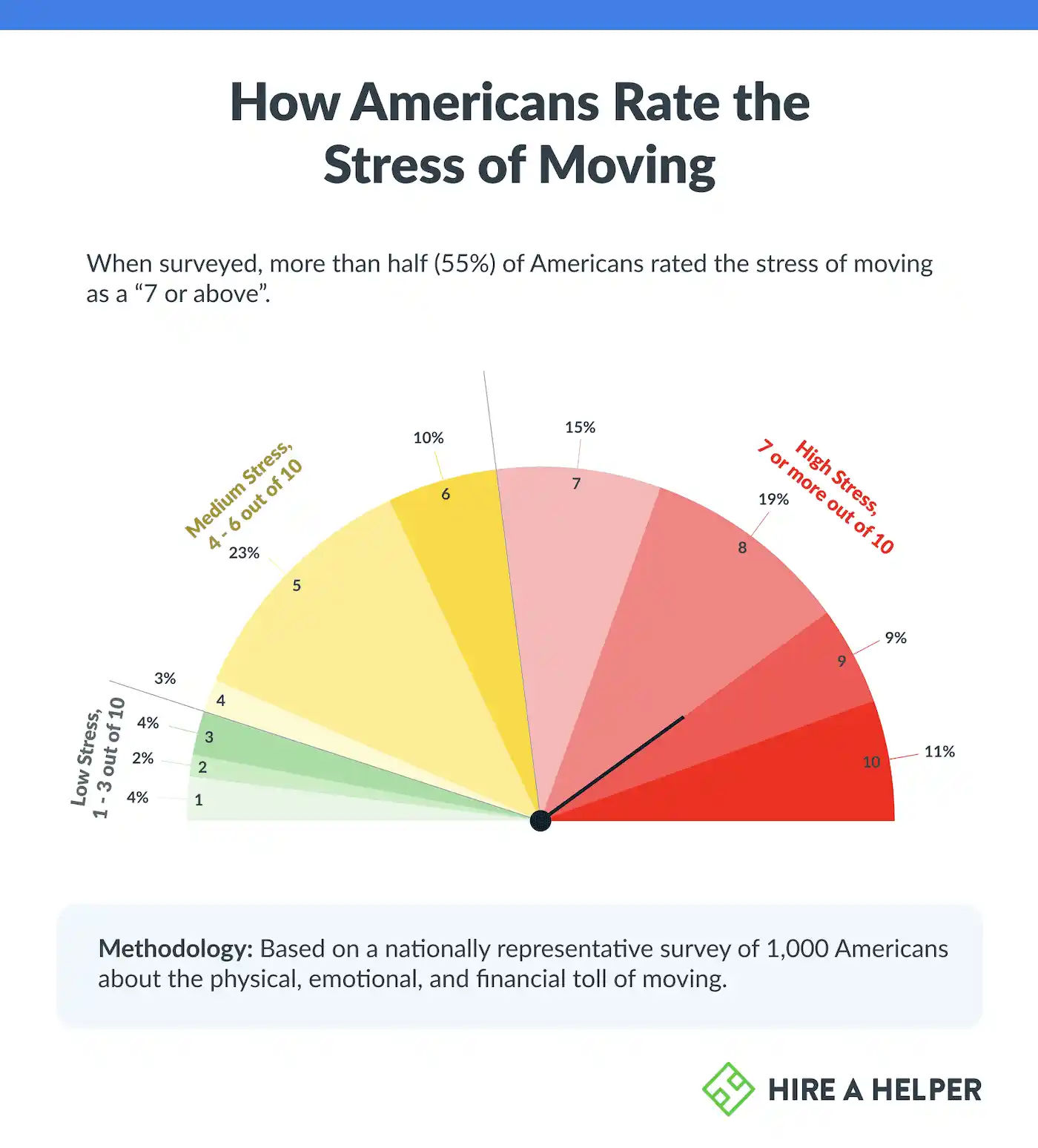
The emotional and psychological toll of moving is no longer something to be assumed, but measurable.
At the heart of this stress is financial strain, which 52% of movers cite as their top stressor. But it’s not just about money. Respondents also pointed to the stress put on their household as a significantly difficult part of moving (41%), along with the change of surroundings and routine (38%). Interruptions to work (30%) and changes in social life (29%) were felt similarly as major contributors to the pressure they felt.
On the physical side of things, nearly half (47%) of respondents said packing was the most stressful pain point. This was closely followed by cleaning the old place (42%) and then relocation logistics like setting up utilities or hiring movers (39%).
Moving doesn't just take a toll on your schedule, it challenges your sense of stability, community, and control. And for a growing number of people, that's not just difficult, it’s harmful.
The Silent Health Crisis Behind Every Move
Behind every move lies a hidden cost unrelated to actual dollars, but in damage to the body and mind. This is especially the case for those who go it alone. Unfortunately, the reality is that not everyone has the luxury of hiring movers or leaning on friends and family for support. For those doing it alone especially, moving becomes a silent health crisis.
In the survey, when asked which parts of a move were most stressful, and one mover shared, “I was extremely sick with COVID and pneumonia.” Another said simply, “Having nowhere to go.” Others were juggling crises like “a house fire that was unexpected and a total loss,” or making impossible decisions like “leaving many possessions behind that I could not take.”
The individual stories highlight a broader trend: moving, especially without help, frequently results in both emotional and physical strain.
Moving presents an increased injury risk
While moving is often viewed as a manageable life event, our data shows it can push people toward physical exhaustion and emotional breakdown. Nearly 1 in 4 Americans report injuring themselves during a move, with 27% experiencing joint pain, 22% back injuries, and 16% neck injuries.
These injuries are even more common among those who take the do-it-yourself approach, which is still the most popular way to move. People who handle their move without professional help are 39% more likely to report joint and neck injuries than those who don’t. While DIY moves may seem cost-effective, the physical toll suggests they come at a hidden cost.
The emotional toll of moving
It’s not just physical harm that can happen during a move. Many Americans also experience emotional symptoms, which are even more widespread. 55% of those who have moved recently report feeling overwhelmed during the task, while 47% have experienced fatigue, 45% felt burnt out, and 37% mentioned they struggled with sleep during the process.
According to Dr. Raj Dasgupta, a quadruple board-certified physician by the American Board of Internal Medicine, chronic stress paired with physical overexertion during a move is a dangerous combination:
“Moving is a major life transition for many people. You're leaving behind familiar spaces, routines, and sometimes relationships, and that all adds up emotionally. From a medical standpoint, your brain perceives big changes like this as a threat, which triggers your stress response. It’s not unusual to feel overwhelmed, anxious, or even physically exhausted during the process.
“Chronic stress hits multiple systems: the cardiovascular system, the immune system, the digestive system, even your brain. Over time, too much cortisol and inflammation can raise your risk for high blood pressure, heart disease, type 2 diabetes, gut issues, and anxiety or depression.”
In a culture that glorifies the individual, Americans are DIYing their way into burnout. Moving is treated like a routine milestone, but for many, it’s a health crisis in disguise.
29% of Americans Would Rather Get a Divorce Than Move
Moving is viewed as more emotionally and physically draining than many of life’s most dreaded events, and it seems Americans would rather tackle other major stressors than pack up and move home.
According to our research, nearly half of Americans (45%) said they’d rather hunt for a new job than deal with the upheaval of a move. 36% of those surveyed said they’d rather have a root canal, 36% would rather have a colonoscopy, and shockingly 21% would rather lose their job than experience the stress of a move.
The most shocking statistic of all is that almost a third of Americans (29%), would rather experience the stress of a divorce than the stress of moving home. With divorce being cited as the second most stressful life event on the Holmes and Rahe Stress Scale with a score of 73 out of 100, moving might be a severely underestimated health risk.
These comparisons speak to the visceral, full-body stress that moving triggers. Dr. Raj, explains why:
“There is strong evidence that chronic stress speeds up biological aging. Stress affects telomeres, the protective caps on your DNA, and when those wear down faster, your cells age more quickly. That’s been linked to a higher risk of early death, especially when stress is constant and unmanaged over time.
“Studies have linked major life changes to spikes in things like heart attacks, hospital visits, and even early death in some cases. Tools like the Holmes and Rahe Stress Scale actually rank events like moving, divorce, and job changes as high-risk for future health problems, especially if they pile up close together.”
In other words, your body can’t tell the difference between moving and surviving a threat. The physiological toll is the same.
Moving Is Far More Stressful Than People Expect
Moving can often feel like a difficult but manageable task before we actually start the long and arduous process of planning, budgeting, and physically moving everything. But the data shows we often grossly underestimate how much work a move actually takes.
Our findings show that 53% of people said moving was more stressful than they expected, with 22% calling it much worse. This gap between expectation and reality can leave movers feeling blindsided and unprepared.
Women are 50% more likely than men to say that moving was “much worse than expected” (26% vs. 17%). This gendered difference may reflect the disproportionate emotional and physical labor women often carry during life transitions, compounded by caregiving responsibilities and social expectations.
Dr. Raj emphasizes how different demographics can experience moving home. “Some groups are more sensitive to different kinds of stress. Older adults, young kids, people with existing mental health conditions, or those who don’t have a strong support system tend to feel the impact more. And if someone already has a chronic illness or financial strain, moving can amplify both physical and emotional stress.”
Men and Women Cope with Moving Stress Very Differently
While moving is universally stressful, men and women tend to experience and manage that stress in markedly different ways.
Men are more likely to focus on the logistical and financial aspects, with 35% naming work interruptions as a top stressor (compared to just 26% of women). In fact, men cite work stress 30% more often than women. They’re also more likely to budget for a move: 77% of men say they set a budget, versus only 60% of women.
But women feel the emotional toll more acutely. Though both groups underestimated how stressful moving would be, women are 50% more likely to describe the experience as much more stressful than expected (25% vs. 17%).
This stress shows up in symptoms, many of which are more prominent than in men:
- 41% of women report difficulty sleeping, compared to 30% of men
- 43% of women report irritability vs. 30% of men
- 62% of women say they felt overwhelmed, compared to 43% of men
- 50% of women experienced burnout vs. 38% of men
And when asked what they’d do to avoid ever having to move again, women were far more likely to put a high price on their peace of mind: 34.8% would pay $10,000 or more, compared to just 25% of men.
Even when it comes to hypothetical tradeoffs, gender differences emerge. Men were 37% more likely than women to say they’d prefer filing for divorce over enduring another move, suggesting that while men may manage the process more practically, the experience leaves its own emotional scar.
Moving Is More Expensive Than People Think, Both Emotionally and Financially
Moving is rarely cheap, but the real cost may be even higher than expected. According to our study, nearly 40% of people said their move cost more than they anticipated, while a third (33%) didn’t set a moving budget at all. In other words, millions are stepping into one of life’s most stressful events without a financial plan, and it’s aggravating their stress.
The data reveals a clear correlation between stress levels and expectations around moving costs. Nearly half (48%) of those who rated their moving experience as highly stressful (7-10 on a 10-point scale) said it ended up costing more than they anticipated. Only 5% of this group reported spending less than expected. In contrast, among those who found moving relatively stress-free (1-3 on the scale), 78% said the cost was either less than or exactly what they expected.
Our data suggests that the burden of financial stress falls across generations, but especially affects Gen X, who are least likely to have budgeted and most likely to cite finances as their number-one stressor.
Boomers, meanwhile, are the most likely to avoid budgeting altogether (58%), while Gen Z, often assumed to be financially impulsive, were actually the most likely to plan ahead, with only 29% skipping a budget.
At a time when housing affordability is already tight, unplanned moving costs can push households closer to debt or instability. While money is an important part of the conversation, the emotional fallout that comes with financial chaos can be the deadliest. Budget overruns often happen alongside other stressors like childcare logistics, job disruptions, or damage to belongings, adding to the psychological load.
A Third of Americans Would Pay $10K to Never Move Again
It’s impossible to talk about moving without talking about how much it costs. But how much would Americans pay to never have to move again?
Our study found that 31% of people say they would pay $10,000 to never have to experience the stress of moving again. Nearly half (49%) say it’s worth at least $5,000 to avoid the emotional and physical toll. And these aren’t trivial sums! The thousands of dollars people are willing to trade to be rid of moving stress speak to the profound impact it has on health and wellbeing.
Some respondents even went so far as to say that there was “no dollar amount” that could be associated with how much they’d pay to never have to move again. Others said “priceless” and “a billion dollars”, showing just how acute the stress of moving is.
Despite these risks, moving remains a largely invisible stressor in our culture, normalized as “just part of life.” This normalization means few people get the support they need to manage it healthily. The willingness to pay thousands to avoid it suggests a deep, unmet need for better systems, from improved moving services to mental health resources, to help people navigate this upheaval with less harm.
HireAHelper’s Tips to Reduce Stress During a Move
While moving is consistently ranked among life’s most stressful events, many of the stressors people face can be reduced with a bit of planning. Whether you're relocating across the country or just across town, the key is to approach your move like any other major life transition: with a clear plan, the right tools, and help when you need it.
Daniel Cobb, Senior Editor at HireAHelper has a few expert-backed tips to help you protect your time, your body, and your peace of mind:
1. Budget Realistically & Consider the Hidden Costs
More than 1 in 3 people don’t set a budget for their move and 4 out of 10 underestimate the cost of their move, which creates so much more stress. Do your best to consider all the facets of your move, set a budget, and leave a little extra room for unexpected costs. Make sure to consider expenses like:
- Packing Materials (you’ll need more than you think!)
- Storage Fees
- Moving Help
- Moving Trucks / Shipping Containers
- Gas (if driving yourself)
2. Weigh the Pros and Cons of DIY Moving
As this survey clearly shows, people consistently underestimate the work required to move. While paying for moving help is an added expense, for the majority of people, it’s a worthwhile expense. Thankfully, there is a great middle ground called “labor-only” where you pay for movers to come load your truck or shipping container. It’s less than half the cost of a traditional move, but significantly reduces the chance of injury and can help to lower overall moving stress. Learn more.
3. Start Packing Early
One of the biggest predictors of a stressful move is waiting until the last minute - especially when it comes to packing. Having a packing plan, and starting that process early is a sure-fire way to reduce stress as you get closer to your move. It gives you time to properly box, declutter, and prepare mentally for your move. Since packing is rated as the most stressful part of moving, it may be worth it to pay for professional packers if you don’t have the luxury of starting 6-8 weeks in advance.
4. Take Care of Your Body
For many, moving is quite a bit more physical exertion than our bodies are used to on a daily basis. If you are doing the physical part of moving yourself, it’s important to lift with your legs, stay hydrated, and listen to your limits. If you start feeling anxious or exhausted, take a break. Your physical and mental health are worth more than shaving 30 minutes off your move.
5. Ask for and Accept Help
There’s much more to moving than physically packing and unpacking boxes. Whether it’s childcare, emotional support, or even ordering a takeaway, don’t hesitate to lean on your circle. Moving is a life event, and like any major transition, it’s not meant to be done alone.
Methodology
This report is based on a nationally representative online survey conducted in July, 2025 with a sample of 1,000 American adults aged 18 and older who have moved residence within the past 12 months. The purpose of the survey was to explore the emotional, physical, and financial impacts of moving, with a particular focus on stress and health effects.
We interviewed Dr. Raj Dasgupta, a quadruple board-certified physician by the American Board of Internal Medicine specializing in internal medicine, pulmonology, critical care and sleep medicine. This interview revealed the exact health effects of moving and how people often react to periods of intense stress.
Latest Research

2025 Charlotte Moving Report
If it feels like everyone’s moving to Charlotte these days, you’re not imagining it! The Queen City is one of the fastest-growing places in North Carolina and the entire Southeast. According to our 2025 North Carolina Migration Report, 147 people move to Charlotte every day, part of a larger trend that has made North Carolina a top-five destination for movers nationwide. It’s drawing talent from across the state and beyond, reshaping how North Carolina grows and cementing its role as one of the country’s most dynamic cities.
We created this report to show what’s fueling that growth, who’s coming here, and what it means for people who already call Charlotte home.

The Future of Homeownership 2026
In 2026, the American Dream is facing a reality check. The median U.S. home price has climbed to $390,300 and is projected to reach $527,525 by 2031 - a 35.1% increase in just five years. But incomes aren't keeping up, despite growing minimum wages. Across the country, the gap between what people earn and what it takes to buy a home is widening fast, pushing homeownership further out of reach for millions of Americans.
This is a nationwide affordability crisis with sharp regional divides. In some states, buying a home still aligns with what the average household earns. In others, even an income of $100,000 falls short.
Using median home prices, household incomes, and five-year projections, this report reveals where Americans can still afford to buy today, where affordability is deteriorating fastest, and which markets may become realistic, or completely out of reach, by 2031.

2023 Study: 3 Million Moves Driven by Extreme Weather Events Last Year
In this study, HireAHelper takes a close look at moves forced by natural disasters in the United States.
Using the most recent data from the Census Bureau’s large-scale Household Pulse Survey and Current Population Survey, we focused on the number of disaster-forced moves over time, their typical destinations, as well as the types of disasters forcing most Americans out of their homes.

Study: How Much Does Moving Cost in 2023?
Driven by record inflation and rising fuel and vehicle costs, U.S. moving costs reached an all-time high in 2022. The average cost that year was $410—peaking at $454 in August—representing a 7% increase from 2021.
Prices have not yet given way; data from the first five months of 2023 shows an average moving cost of $399, which is 4% higher than the same period last year. It remains uncertain whether these costs will stay elevated or decline, which states will experience the sharpest price hikes, and if any areas will become cheaper.

2023 Study: Corporate Relocation at Highest Rate Since 2017
Whether to cut costs, gain a more beneficial tax rate, or be closer to a target market, about 9% of corporations in the United States moved their headquarters within the past fiscal year — the highest percentage since 2016-17, according to Securities and Exchange Commission (SEC) filings.
States like New York and cities like Seattle are seeing corporate headquarters move away, while smaller cities outside large urban centers are becoming new homes to big companies in tech and pharmaceuticals. Our study breaks down where companies are moving to, which states and cities they’re leaving behind, and whether workers are on board with following their employer to their new HQ location.

2023 Study: Where, How and Why Are Americans Moving This Year?
Every year, millions of Americans move, and over half (52%) of those moves take place during what we in the moving business call “moving season” — otherwise known as the summer months of May through August.
So what does the moving season hold for us this year? To get a sense of how many Americans intend to move, when they’re going to move, and what drives their moving decisions, HireAHelper conducted a nationally representative survey of 2,000 adults in the U.S. earlier this month.