Average Apartment Size: Square Footage by Type and City 2026

Historic apartment buildings with ornate facades and exterior fire escapes in a city neighborhood

The average apartment size in the United States is 1,052 square feet. And space is a big deal for Americans, especially when it comes to rentals, where every square foot counts. Apartment size shapes how people live, what they pay, and even how cities grow.

To get the clearest view of how that space has changed over time, we used data from the U.S. Census Bureau’s American Housing Survey to break down the average apartment size by layout and location. Here is what the numbers reveal and what they mean when you are planning a move.


Last updated: Mar 06, 202611 min read
Karen Bodkin
Written byKaren Bodkin

Key Takeaways

  • The overall average apartment size in the United States is 1,052 square feet as of Q3 2025.
  • The majority of apartments (45.2%) are 2-bedroom units.
  • The average size of a studio apartment is 440 square feet, whereas a 1-bedroom apartment is 804 square feet, a 2-bedroom apartment is 1,089 square feet, and a 3-bedroom apartment is 1,593 square feet on average.
  • Apartments in San Francisco average 562 square feet, some of the smallest in the U.S.
  • The average size of a New York City apartment is 779 square feet.
Karen Bodkin
Author

Karen Bodkin

Karen Bodkin is a writer at HireAHelper who's passionate about helping people navigate their moves with less stress and more confidence. She empowers readers by turning the many overwhelming parts of moving into clear, actionable guidance.

Karen draws from a broad writing portfolio that includes home improvement, health, and travel. Her work reflects a deep understanding of life's transitions and a genuine drive to make moving feel more manageable for everyone.

Average Apartment Size in the U.S.

Across the U.S., apartment sizes range from compact studios to spacious three-bedroom units. The national average apartment size is 1,052 square feet, but that number shifts depending on the floor plan. Studios are the most compact, while three-bedroom units offer the most space.

Here is the breakdown of the average size for each floor plan type in the U.S.:

Floor Plan TypeAverage Size
Studio440 sq. ft.
1-Bedroom804 sq. ft.
2-Bedroom1,089 sq. ft.
3-Bedroom1,593 sq. ft.
Overall Average1,052 sq. ft.

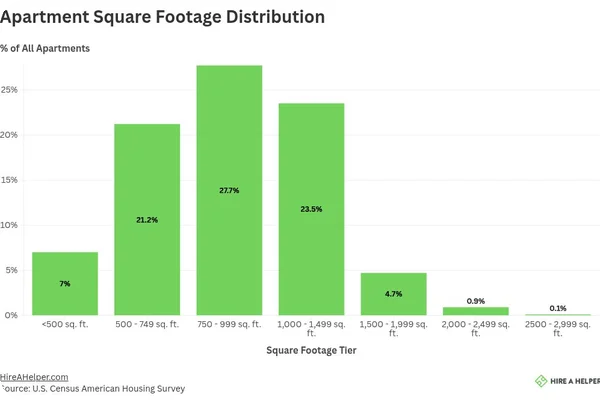
To better understand how rental space is spread across the country, we can look at the square footage distribution. This data highlights the specific range of sizes most common in the market today. A bar chart of apartment square footage tiers by percentage distribution. The majority of apartments (72.4%) fall within the 500 - 1,499 square foot range, most commonly 750 - 999 square feet (27.7% of all apartments)These averages and market data show that most renters (83.4%) live in units with one or two bedrooms. Specifically, the heart of the national rental market lies between 500 and 1,500 square feet, with 21.2% of apartments measuring 500-749 square feet, 27.7% 750-999 square feet, and 23.5% 1,000-1,499 square feet. Larger apartments above that range make up a much smaller share, as only 4.7% of apartments are 1,500 to 1,999 square feet, while ultra-compact units under 500 square feet represent just 7% of the market.

But when you look at the specific floor plans people rent, two-bedroom units dominate the landscape.

Share of U.S. Rentals by Floor Plan Type

Floor Plan TypeShare of U.S. Rentals
Studio8.1%
1-Bedroom38.2%
2-Bedroom45.2%
3-Bedroom8.5%

Two-bedroom units make up nearly half (45.2%) of all apartments in the country. One-bedroom and studio apartments together represent roughly the same share, which shows just how many renters live in smaller spaces.

Most renters (83.4%) occupy units with one or two bedrooms, which aligns with national moving trends. For many, these modestly sized homes offer just enough space to live comfortably without feeling weighed down by extra rooms or higher rent.


Apartment Size Trends Over Time

Despite the common belief that apartments are getting bigger, data shows that after peaking in Q4 of 2024 at 1,127 square feet, the average size of new apartments has fallen by roughly 6.7% to 1,052 square feet as of Q3 2025. This shift reflects a broader trend where apartment sizes have generally decreased over the last few decades, though they often fluctuate quarter to quarter.

Has the average apartment size increased or decreased?

While there was a significant spike in late 2024, the long-term trend shows a decrease in space. For example, the average size in the early '90s was around 1,150 square feet, significantly larger than today's average of 1,052 square feet. Over the last few years, national averages have mostly bounced between 1,020 and 1,080 square feet before the recent 2024 peak and subsequent drop.

Why apartments got smaller

Several factors drive the trend toward smaller units. More people are moving into dense city centers where space is at a premium, and there is a rising number of people living alone. To keep units affordable in these high-demand areas, builders have shifted their focus toward offering prime locations and extensive shared amenities — like rooftop decks and fitness centers — instead of larger individual floor plans.

Why apartment sizes are increasing again

While the general trend is down, sizes occasionally "increase" again during certain quarters, as seen in the jump between Q1 2025 (1,028 sq. ft.) and Q2 2025 (1,113 sq. ft.). These temporary increases usually happen when developers start more projects in suburban areas or in the South and Midwest, where land is more available and larger multi-family units are more common.

These averages and market data show that most renters (83.4%) live in units with one or two bedrooms. Specifically, the heart of the national rental market lies between 500 and 1,500 square feet, with 21.2% of apartments measuring 500-749 square feet, 27.7% 750-999 square feet, and 23.5% 1,000-1,499 square feet. Larger apartments above that range make up a much smaller share, as only 4.7% of apartments are 1,500 to 1,999 square feet, while ultra-compact units under 500 square feet represent just 7% of the market.
But when you look at the specific floor plans people rent, two-bedroom units dominate the landscape.

Share of U.S. Rentals by Floor Plan Type

Floor Plan TypeShare of U.S. Rentals
Studio8.1%
1-Bedroom38.2%
2-Bedroom45.2%
3-Bedroom8.5%

Two-bedroom units make up nearly half (45.2%) of all apartments in the country. One-bedroom and studio apartments together represent roughly the same share, which shows just how many renters live in smaller spaces.

Most renters (83.4%) occupy units with one or two bedrooms, which aligns with national moving trends. For many, these modestly sized homes offer just enough space to live comfortably without feeling weighed down by extra rooms or higher rent.


Apartment Size Differences by City Metro Area

The definition of an "average apartment" varies significantly depending on the geography of the U.S. rental market. Regional data shows a stark contrast in available space, particularly between dense coastal hubs and more expansive southern or midwestern metros.

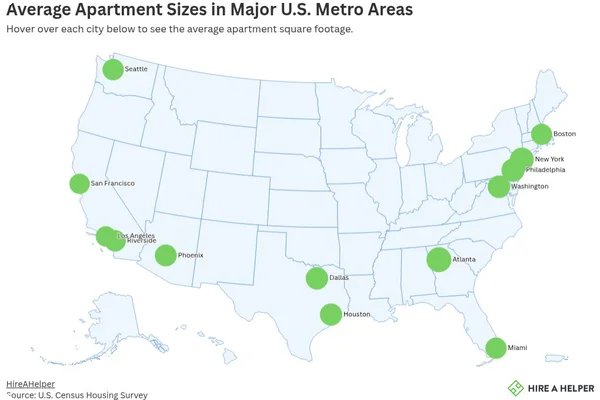
Hover over each city below to see the average apartment square footage. A U.S. Map that shows major metropolitan areas Atlanta, New York City, Philadelphia, Detroit, etc. and their average apartment square footage. For example, Atlanta apartments average 846.5 square feet, New York City's average is 778.9 square feet, etc.Data from the U.S. Census Bureau highlights these regional gaps with specific numbers. In San Francisco, renters work with some of the smallest footprints in the country, averaging just 562 square feet. New York City follows a similar pattern with an average of 779 square feet. On the other hand, cities like Houston and Charlotte offer much more room on average, reflecting the increased availability of larger floor plans in those markets.


Note: The data in this specific section reflects all rental units, including standalone homes and townhouses. This broader scope provides a more comprehensive view of the regional space constraints renters face across the country.

Average Apartment Size vs. Home Size

When looking at the national landscape, it is helpful to compare apartment living to other types of housing to understand how much space you are actually getting.

Is 900 sq. ft a small apartment?

While 900 square feet might feel small compared to a house, it is not considered small for a rental. In fact, it sits comfortably near the national average of 1,052 square feet. Most renters live in spaces between 500 and 1,500 square feet, so a 900-square-foot unit is a standard, mid-sized option in most markets.

Size in apartments vs houses

There is a massive difference in scale between apartments and houses. According to the U.S. Census Survey of Construction, the average size of an apartment is 1,052 square feet, compared to 2,405 square feet for a single-family housing unit as of Q3 2025. This means a typical house offers more than double the living space of a standard apartment.

Average apartment size vs condo

The average size of an apartment versus a condo is essentially the same. The technical difference between the two boils down to ownership rather than the physical structure. While condos might offer different amenities or higher-end finishes, they follow the same regional size patterns as standard apartments.


Why Apartment Size Matters

When we talk about average apartment size, we are talking about the total square footage of your rental, which includes everything from the kitchen to the bedrooms. This number is more than just a data point, since it shapes your lifestyle and your moving budget.

“...[The] average size of new apartments has fallen by roughly 6.7% to 1,052 square feet as of Q3 2025.”

The size of your apartment dictates how much furniture you can bring and what kind of equipment you need to move it. Movers also use square footage to estimate the number of people, hours, and trucks required for the job. Since more volume typically equals more time and effort, a larger space often leads to a higher total price.

If you are planning a move, use these general square footage benchmarks to estimate your needs:

  • Studio (under 500 sq. ft): These units usually fit into a 10-foot truck. If you need storage, a 5x5 or 5x10 unit is typically enough.
  • One-bedroom (around 700-800 sq. ft): You will likely need a 15-foot truck and a few more hours of labor than a studio move. A 10x10 storage unit is a standard choice for this size.
  • Two-bedroom (1,000+ sq. ft): A 20-foot truck is commonly necessary. Depending on your furniture, you may need three or more movers and a storage unit between 10x15 and 10x20.

Beyond raw square footage, remember that layout matters. An open 700 square foot floor plan can be easier to navigate than a larger 900 square foot place with narrow hallways or steep stairs.


Estimating Your Space & Planning the Move

Getting a handle on your new apartment’s size before you move in can save you a lot of hassle later. Here’s how to figure out what you’re working with and plan accordingly.

Start with the basics

If you’re still apartment hunting, most listings include square footage. Write it down or screenshot the number since you’ll want to reference it later. If you’ve already signed a lease, your landlord or property manager can tell you the exact size. Some apartment complexes even have floor plans you can look at online or in the lobby, which is super helpful for visualizing where your furniture might go.

Measure your biggest stuff

Couple measuring a large refrigerator to ensure it fits before moving

Grab a tape measure and check the dimensions of your couch, bed frame, dresser, and any other large pieces you’re planning to bring. Then think about whether they’ll actually fit in your new place. A king-size bed might work fine in a two-bedroom apartment, but it could dominate a smaller one-bedroom in a way that makes the room feel cramped.

Do a quick inventory

Walk through your current place and get a sense of how much you own. Count how many boxes you think you’ll need for books, kitchen stuff, clothes, and everything else. If you’re unsure about the size of boxes to use for different items, our moving boxes size guide provides a clear breakdown.

Declutter before you pack

Moving is the best time to get rid of things you don’t use anymore. Less stuff means fewer boxes, a faster move, and an easier time settling into your new place. Plus, if your new apartment is smaller than your current one, you’ll need to downsize anyway, so you might as well do it as soon as possible instead of dealing with it in a rush later.

Think about the layout early

Once you know the size and shape of your new apartment, start planning where things will go. Which wall makes the most sense for your couch? Where’s the best spot for your bed?

If you have a rough plan before moving day, you can direct the movers (or your friends helping you) instead of making decisions on the fly when everyone’s tired and just wants to be done.

Pack with a timeline in mind

Start early with things you don’t use every day, like books, decor, and off-season clothes. Leave the essentials for last. The more organized you are going in, the smoother everything goes when it’s time to move.


Why Trust HireAHelper: Our Methodology

At HireAHelper, we have been in the moving business for a long time, and we know that having solid information makes the process much easier. That is why we ensure the numbers in this article come from the most reliable sources available.

To provide the most accurate picture of the rental market, we use data from two primary government sources:

  • U.S. Census American Housing Survey: We use this data to understand the differences between average square footage and floor plans, average square footage distribution, and average square footage by city.
  • U.S. Census Survey of Construction: We rely on this survey to get the most up-to-date numbers on the overall average apartment size and data variations by region.

We excluded detached rentals, mobile homes, and houseboats from our calculations, so the results reflect apartments only. Accuracy matters to us because people rely on our platform for real, useful moving information. Our goal is to help you plan your move with data you can actually trust.


Frequently Asked Questions

Recent Articles

A person in work clothes holds a tablet while inspecting a room during a move-in walkthrough

How To Do A Move-In Walkthrough And Document Everything

Move Planning

Moving into a new place already comes with a ton of tasks to keep track of, so you might not think to do a close inspection of your new home. However, undocumented pre-existing damage is the number one cause of... Read More

A stressed man surrounded by moving boxes talking on the phone

What To Do About a Bad Landlord

Move Planning

If you are dealing with a bad landlord at any stage of moving or living situation, start by documenting everything, communicating in writing, and making sure you understand your legal rights as a tenant. This... Read More

A person reviewing moving finances with bills and a calculator at a new home

What Are Move-In Fees vs. Security Deposits?

Move Planning

A move-in fee is a one-time cost that won't be returned to you, while a security deposit will be returned to you at the end of your lease. They aren't the same, and confusing them can cost you.

Knowing the... Read More

several types of furniture sit against a wall

Where to Throw Furniture Away: 7 Easy Disposal Options

Move Planning

When you're moving or downsizing, not all of your furniture will come with you to your new home, and it's not always easy to figure out how and where to throw furniture away. Many cities provide free or paid... Read More

image of a checklist

Moving Checklist: A Step-by-Step Timeline for a Smooth Move

Move Planning

Moving an entire home is a major feat, even for the savviest of planners. It's easy to feel overwhelmed, which is why the best moving checklist is a timeline-based one that breaks your move into manageable steps... Read More

Cardboard moving boxes packed and ready in the bedroom of a new home

Preparing to Move: What You Need to Know Before You Start Packing

Move Planning

Preparing to move starts with planning: outlining your moving needs, setting a budget, and clearing out clutter before you pack a single box. Moving can be emotionally and logistically heavy, and while it’s normal... Read More