Types of PCS Moves Explained
If you receive PCS orders, you have a deadline to move. Fortunately, you don’t have to cover the cost entirely on your own. The military provides several relocation assistance options.
Government-Arranged Move (HHG Move)

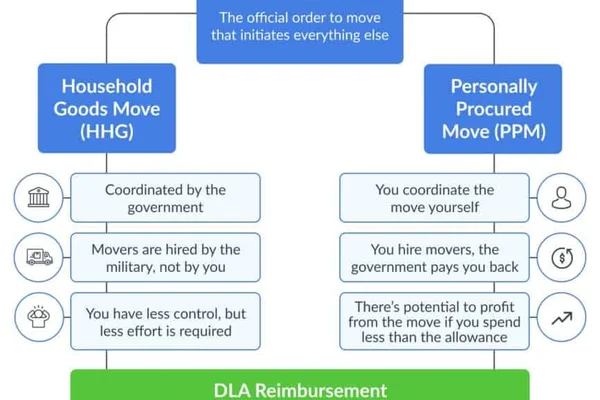
In a Household Goods (HHG) move, the military takes the lead. A Transportation Service Provider (TSP) handles the loading and transport of your household goods. Your weight allowance for this option depends on your rank and whether you have dependents. It’s important to stay within these limits, as you may have to pay out of pocket if your shipment is over the allowed weight.
The biggest benefit of an HHG move is that it requires very little upfront cost or physical labor from you. However, you do give up a lot of control. You can’t choose the specific moving company or the exact delivery date. While it’s the most hands-off option, many families find the lack of flexibility and the risk of damaged items to be a drawback.
Personally Procured Move (PPM / DITY Move)
A Personally Procured Move (PPM), often called a DITY move, allows you to handle the move yourself. The government compensates you for 100% of what it would have cost them to move you, which can often result in extra cash in your pocket if you stay under budget.
This option is perfect for those who want total control over their timeline and belongings. You can even choose a Full PPM or a Partial PPM depending on your needs. Just remember that you must keep every receipt and document. While you can save money, the downside is the added responsibility. You’re in charge of every detail, from booking the truck to organizing all the paperwork. Thankfully, you can use tools like our platform to find labor-only movers who can load your rental truck, helping streamline some of the moving process.
Mixed PCS Moves (Partial PPM)
A Partial PPM is often the sweet spot for military families. In this scenario, the government moves the bulk of your furniture, but you move a portion of your belongings yourself in your own car. This is useful for transporting high-value items, professional gear, or things you’ll need right away.
The main advantage is flexibility. You get the convenience of a government move for the heavy stuff while ensuring your most important items stay with you. Plus, you still receive a government payment for the weight you transport yourself. The only real drawback is that you have to manage two separate moving processes at once.
DLA Reimbursement
Dislocation Allowance (DLA) is a specific payment intended to help cover the miscellaneous expenses of relocating. Think of it as a buffer for those hidden/extra costs, like deposits and utility hookup fees. It’s not tied to the weight of your household goods but rather to the fact that you’re moving your household to a new duty station.
DLA is especially helpful during the first few weeks at a new station when expenses tend to pile up quickly. Most service members are eligible, but you usually have to apply for it through your finance office.
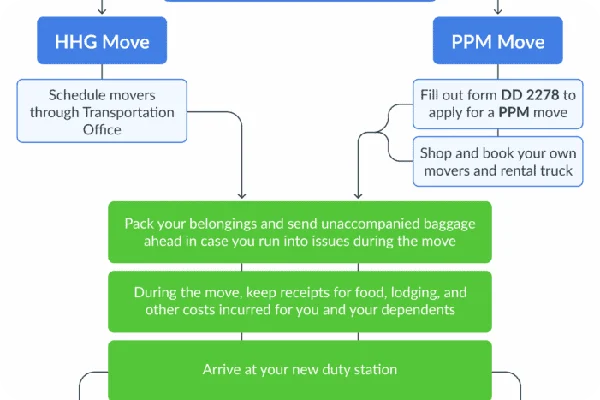
Still confused? Here’s a handy graphic that shows you the differences:




 Melanie MorrisJul 25, 2025