Can You Ride with Your Movers?

two movers in work overalls sit in the bed of a truck and look at the camera

The short answer is: no, you normally can’t ride with your movers in their truck. Most moving company policies prevent it because of liability concerns and insurance limitations.

Also, many moving trucks only have enough seats for the professional team, and if there’s no room, you won’t be able to ride in the cargo area either. Plenty of states have laws prohibiting passengers in cargo areas.

 The Federal Motor Carrier Safety Administration (FMCSA) states that you can only ride in a cargo area if it's designed to protect passengers in the event of a crash. Because moving truck cargo areas typically don't have seats, seat belts, or other protections, it’s not legal—or safe—to ride in them.

Last updated: May 1, 20253 min read
Melanie Morris
Written byMelanie Morris

Key Takeaways

  • Most moving companies don't allow customers to ride in the moving truck: DOT regulations, insurance limits, and safety policies all play a role
  • Insurance is the biggest blocker: commercial-truck policies typically exclude passenger coverage for non-employees
  • Exceptions exist for some short or local moves, especially with smaller independent crews — but always confirm in writing before move day
  • Alternatives include driving your own car/rental, flying, or using a service like Auto Transport: if you're moving cross-country and only have one vehicle
  • For long-distance moves, plan transportation separately — your stuff and you don't need to arrive at the same time
Melanie Morris
Author

Melanie Morris

Melanie Morris is an editor, writer, and one of the sharpest moving experts at HireAHelper. Seven years spent answering readers' toughest questions and demystifying a process most people dread has made her an authority on what movers actually need to know — and how to explain it without the jargon. Her own relocations around the Southwest and up and down the West Coast give her the firsthand experience to back it up. Whether you're crossing the country or just moving down the block, Melanie makes sure the advice you get is accurate, trustworthy, and easy to act on.

What Are Moving Company Policies on Passenger Travel?

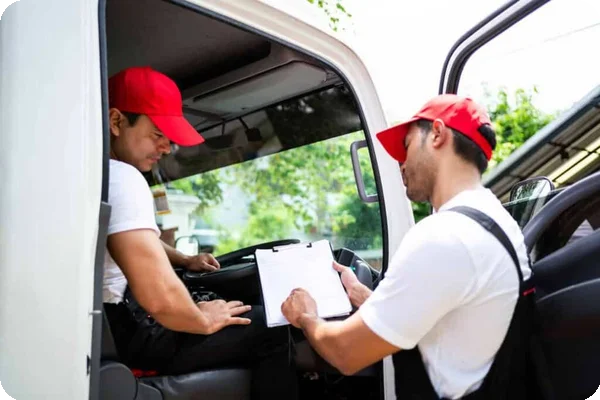
One mover in a red hat discusses something on a clipboard with his colleague sitting in the bed of a truck

Most moving company policies prohibit passenger travel. There are several reasons why this policy is in place, including:

  • Increased liability risk: Moving companies already take on a pretty high liability risk. They may cover costs related to property damage that occurs in transit, including in an accident. For example, if the box truck overturns in a wind gust, the moving company may cover the cost to replace or repair your items. However, taking on a passenger adds another layer of risk—the company could be held liable for any injuries that the passenger might sustain. To avoid this and the expense that comes with it, company policies often prohibit passengers.
  • Insurance doesn't cover it: Your moving service's insurance company may not cover passengers at all. In such a case, allowing a passenger could put the moving company at risk of having claims denied.
  • Not enough room: Many moving trucks are only designed to hold a few people. All seats secured by seat belts may be taken up by the moving team.
  • Potential distraction for the driver: Businesses might not allow you to ride in a moving truck because untrained passengers might be seen as a potential distraction. That could increase the risks of an accident during transport.

In very rare cases, especially for local moves or when using an independent moving service, the company might allow a passenger, but only with prior approval. Always confirm the policy directly with your mover before moving day.

Are There Safety and Insurance Considerations?

Yes, there are critical safety and insurance factors to consider before you opt to ride with your movers, even if they allow it.

"The Federal Motor Carrier Safety Administration (FMCSA) states that you can only ride in a cargo area if it's designed to protect passengers in the event of a crash."

First, consider your own safety. If there isn't an option for sitting in the cab of the truck, you might eye the cargo area. But riding in the cargo area increases your chance of injury, even if the truck isn't involved in an accident. Here’s why it’s especially dangerous:

  • No seats or seat belts: There are likely no seats and seat belts, creating a legal issue as well as a safety concern.
  • Jostling and falls: You could fall or be jostled around as the moving truck navigates curves and turns.
  • Shifting cargo: Boxes and other items might fall on you or slide into you.

Second, consider the insurance implications. Many moving companies have insurance that covers your belongings, but not you. The policies are often designed only to cover injuries to the employed moving team should an accident occur. If you choose to ride in the moving truck anyway and are injured, you might be on the hook for your own medical expenses.


Are There Any Special Circumstances and Exceptions?

Moving truck passenger rules vary with location and company. If you're making a local move with a small team, you might find a company willing to let you ride in the moving truck. However, this is very rare. If riding along is important to you, be sure to ask about the company’s policy before you book—and get written approval, ideally via email.

Recent Articles

movers

Are You Supposed to Help Movers? What to Do While Movers Are Moving Your Stuff

Moving Day Tips

No, you're not supposed to help movers lift boxes or carry furniture. Stepping in uninvited can create real liability issues for you and the crew you hired, in addition to slowing things down.

Even though you're not... Read More

A person spreading rock salt onto an icy driveway after a winter storm

Should You Use Salt or Sand on an Icy Driveway?

Moving Day Tips

Although summer is the most popular moving season for several reasons, moving in the winter also comes with plenty of advantageslike scoring lower rates thanks to off-peak season pricing.

However, there's one... Read More

a red and white sign that says the area is only for parking with a permit

Moving Permits 101: How To Get a Parking Permit for Moving

Moving Day Tips

A parking permit is official documentation from the local government that allows you to legally park your moving truck or container. To get one, you'll need to check the city's regulations, complete an application,... Read More

a view through a truck's windshield at a rainy highway

Here's How the Pros Move in the Rain

Moving Day Tips

You'd hope rain would stay away on moving day, but until a weather machine is invented, moving in the rain remains a possibility. Unless the storm turns into a hurricane or flooding, most movers continue operating... Read More

Denver CO skyline with highway traffic and downtown skyscrapers at sunset

Do You Need Parking Permits for Moving in Denver?

Moving Day Tips

You’ve packed, labeled your boxes, scheduled movers, and checked your moving list twice. But what about parking? Denver’s busy neighborhoods, narrow streets, and metered zones can make parking a moving truck or port... Read More

Charlotte NC skyline view with Uptown skyscrapers and colorful buildings

Do You Need Parking Permits for Moving in Charlotte?

Moving Day Tips

When you’ve packed every box, labeled every room, and scheduled your movers, the last thing you want to derail your moving day is costly fines. Charlotte's Uptown congestion and historic neighborhoods make curb... Read More