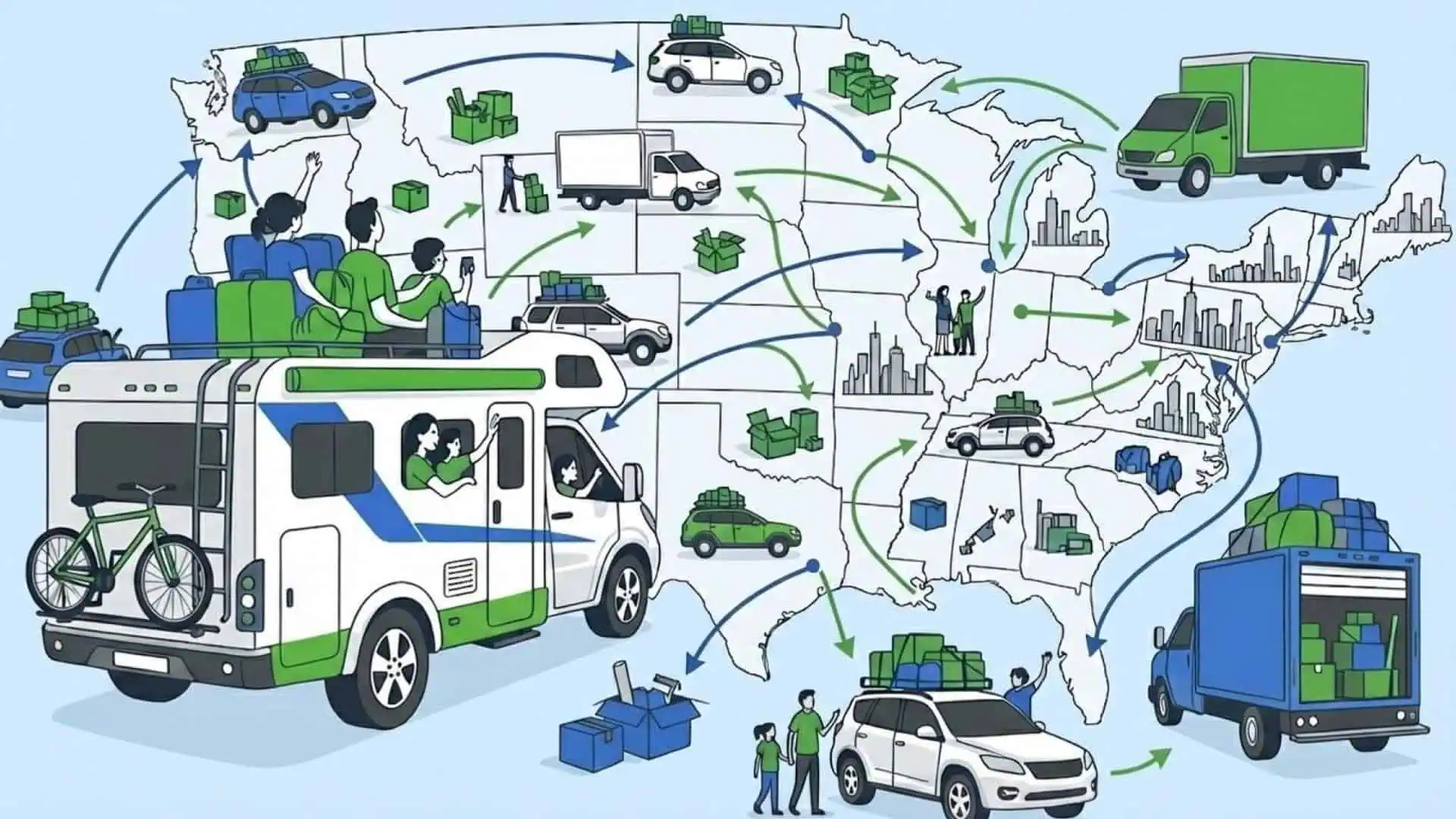
The 2026 HireAHelper Moving Migration Report
In 2025, Americans didn't stop moving, but how and where they moved shifted in meaningful ways. More people chose to relocate within their own state rather than cross long distances, smaller metros outpaced major cities on a per-capita basis, and economic opportunity mattered more than just lifestyle alone. Together, these patterns point to a year defined less by dramatic relocation and more by deliberate, calculated moves, shaped by affordability, job stability, and long-term financial considerations.
The 2026 HireAHelper Migration Report is our annual deep dive into how, where, and why Americans moved in 2025. Now in its fifth year, the report reveals what made 2025 distinct: a slower overall moving year that still produced intense migration pressure in specific states and metros, particularly across the Southeast and select secondary markets.
Key Takeaways
- Almost 15 million U.S. adults moved in 2025 according to our data, which accounted for over 4% of the adult population.
- 78.49% of all moves were intrastate, showing most Americans stayed within their home state.
- South Carolina led the nation in net migration per capita, gaining 79.7 residents per 10,000 people.
- Lower cost of living strongly correlated with positive migration, especially in the Southeast and Mountain West.
- Younger generations clustered in D.C., while older Americans gravitated toward New England states.
Table of Contents
- How Many People Moved in 2025?
- 2025 Migration Trends by State
- 2025 Migration Trends by City
- Moving Season: A Slower Year Overall
- Who Moved in 2025? A Demographic Breakdown
- Interactive Comparison Tool for City and State Migration
- What 2025 Moving Trends Reveal
- Methodology
About This Report
HireAHelper's Migration Report is an annual analysis of U.S. domestic migration trends, published each year since 2019. Migration trends reflect changes in the economy and American values beyond what is evident in the real estate market.
This analysis is based on PGM's database of 14,977,223 adult moves tracked for the full year of January 2025 through December 2025. Unlike other studies restricted to lagging census releases or modeled estimates, this exclusive dataset captures real-time relocation activity over the past 12 months. This provides a unique, high-fidelity lens into U.S. migration patterns that is unavailable through public channels.
How Many People Moved in 2025?
In 2025, our data captured 14,977,223 U.S. adults who moved, accounting for 4.46% of the country's adult population. At first glance, that percentage may seem relatively small, but it represents millions of households making significant, often life-changing decisions about where to live. Taken together, those individual moves help reshape housing markets, redefine labor forces, and influence the economic direction of states and cities across the country.
Most Americans who moved in 2025 didn't go far. In fact, 78.49% of all moves – more than 11.7 million – took place within the same state, highlighting just how dominant intrastate migration remains. Even so, more than 3 million Americans crossed state lines, reinforcing that interstate migration remains a meaningful and persistent part of U.S. mobility.
- 11,756,200 (78.49%) were within the same state
- 3,221,023 were across state lines
States with the Highest Net Gains (Total Residents)
When migration is measured strictly by total net population change, the largest states naturally rise to the top. States like Texas, which added 68,318 residents, and South Carolina, which gained 41,548, benefited from their size, housing availability, and sustained demand. Tennessee, North Carolina, and Alabama also posted significant gains, continuing broader population shifts toward the South.
States with the Largest Net Losses
On the other end of the spectrum, several highly populated states experienced substantial net losses. California led the nation in resident departures, losing 98,568 people, followed by New York, Massachusetts, Illinois, and Maryland. These losses don't necessarily signal long-term population decline, but they do reflect mounting pressures around affordability, housing availability, and cost of living in many of the country's largest markets.
Together, these figures reinforce a simple truth: big states tend to see both big gains and big losses. However, raw population totals only scratch the surface. To understand where migration is having the greatest impact, it's essential to look beyond sheer volume and examine how these changes affect states relative to their existing populations.
2025 Migration Trends by State (Per Capita)
When migration trends are adjusted for population size, a different picture emerges. Instead of highlighting only the largest states, a per-capita view reveals where population change is most concentrated, and where its effects are most likely to be felt by residents, employers, and local housing markets.
By this measure, South Carolina led the nation in 2025, with a net gain of 79.7 residents per 10,000 people. That level of growth is transformative, which can put immediate pressure on housing supply, accelerate job creation, and reshape local economies in a relatively short period of time.
Idaho followed closely behind, adding 63.2 residents per 10,000, continuing a trend of a strong influx of residents driven by affordability and quality-of-life factors. Delaware ranked third, with a net gain of 54.5 per 10,000 residents, benefiting from its proximity to major East Coast job markets. It also maintains a comparatively lower cost of living due to the state boasting no sales, estate, or social security taxes.
Rounding out the top five were Tennessee and Alabama, which added 43.6 and 36.6 residents per 10,000 people, respectively. Both states have become increasingly attractive to movers seeking lower taxes, more affordable housing, and growing employment opportunities across the Southeast.
Together, these states illustrate how per-capita migration reveals the real hotspots of population growth in 2025. Namely, places where even modest absolute numbers translated into an outsized impact on communities and local infrastructure.
Monthly Trends Reveal Momentum
Looking beyond annual totals, monthly migration data reveals where momentum built, and where it steadily declined, throughout 2025. Washington, D.C. consistently experienced the highest per-capita outflow in the country, with an average of 7.6 residents leaving for every 10,000 people each month. Rather than a single spike, the data shows a sustained pattern of departures, signaling ongoing pressure from housing costs, remote-work flexibility, and shifting lifestyle priorities.
In contrast, South Carolina and Idaho stood out for their steady monthly inflows. Both states welcomed new residents at a consistent pace throughout the year, reinforcing the idea that their migration gains weren't driven by one-off events but by enduring economic and quality-of-life advantages.
Seasonality also played a clear role. August emerged as the most active migration month, particularly across the Southeast, as families timed moves around the end of summer and the start of the school year. The spike underscores how traditional moving seasons continue to shape migration patterns.
States Driving America's Migration Trends
South Carolina: Jobs Are the Magnet
South Carolina's migration gains in 2025 weren't driven by affordability alone; they were powered by opportunity. The state has quietly become one of the strongest job markets in the Southeast, thanks to sustained growth in logistics, healthcare, and advanced manufacturing. As employers continue to expand operations across the state, particularly along major interstate corridors and coastal metros, workers follow.
This job-driven growth translated into consistent monthly population gains throughout 2025, rather than short-lived spikes. South Carolina welcomed more new residents per capita than any other state, an indication that its labor market is not only attracting attention but converting interest into long-term relocation decisions.
Idaho: Affordability Meets Quality of Life
Idaho's migration momentum continued into 2025, extending a multi-year trend fueled by a rare combination of relative affordability and lifestyle appeal. Compared to neighboring Western states, Idaho remains significantly more accessible in terms of housing costs, even as prices have risen nationwide. That affordability, paired with access to outdoor recreation and less-congested metros, has made the state especially attractive to remote workers and retirees alike.
Rather than being concentrated in a single season, Idaho's gains were spread consistently across the year, signaling durable demand. Monthly inflows suggest that movers aren't simply reacting to short-term economic conditions, either, but are instead making intentional, long-term choices about where they want to live.
Tennessee: Nashville is Becoming the New Austin
Tennessee's appeal in 2025 went beyond its long-standing tax advantages and increasingly centered on economic momentum, particularly in and around Nashville. While the state's lack of income tax continues to attract residents looking to maximize take-home pay, Tennessee's migration surge mirrors a pattern seen earlier in Austin, Texas: a convergence of job growth, cultural appeal, and investor confidence. In fact, Tennessee's net migration rate per capita closely tracked Austin's peak-era growth, underscoring how similar forces are now at play.
Nashville, in particular, has become a focal point for this shift. Major corporate investments, including Oracle's decision to relocate its global headquarters to Nashville and Amazon's expanding Operations Center of Excellence downtown, have added thousands of high-paying tech and corporate jobs, diversifying the city's economy well beyond its historic music roots.
While Austin's tech-heavy economy and job market entered a cooling and normalization phase in 2024 and early 2025, Nashville's three-pillar foundation – healthcare, technology, and logistics – has proven more resilient. That stability is reflected in housing trends as well: Nashville's luxury market remained robust throughout 2025, with prices holding steady and the share of million-dollar listings surpassing Austin's in select tiers.
Together, these forces helped drive a steady inflow of new residents throughout the year, peaking in August when Tennessee added 12.7 new residents per 10,000 people, reinforcing Nashville's growing reputation as the next "safe bet" destination for high-income and career-driven movers.
Migration vs. Cost of Living
Cost of living continues to be one of the most powerful forces shaping where Americans choose to move. In 2025, the relationship between affordability and migration was especially clear: states that offered lower everyday expenses consistently attracted more new residents on a per-capita basis.
Oklahoma, Mississippi, and West Virginia rank as the three least expensive states to live in, and all three landed within the top 15 states for net migration per 10,000 residents. Their performance reinforces the idea that when housing, utilities, and daily necessities remain accessible, people are far more willing to relocate.
At the same time, affordability alone doesn't tell the entire story. Texas, which saw the largest net population gain overall, ranked 14th on the cost-of-living index — not the cheapest, but still below the national median. Its strong job market, housing availability, and economic diversity helped offset higher costs in certain metros, making the state attractive to a broad range of movers.
South Carolina provides an even clearer example of how affordability and opportunity intersect. Despite ranking 24th for cost of living, the state led the nation in per-capita migration. That gap suggests job growth, rather than low prices alone, played a decisive role in attracting new residents, particularly in industries experiencing sustained expansion.
What's equally telling is where movers didn't go. Notoriously high cost of living states like California, New York, and Illinois all saw negative migration. The absence of those states from the growth side of the map underscores a growing constraint in U.S. migration: even strong economies struggle to attract new residents when affordability barriers become too high.
2025 Migration Trends by City
When migration patterns are examined at the city level, one trend stands out immediately: the biggest winners in 2025 weren't solely major metros, but more mid-sized and smaller markets. Rather than gravitating toward the largest urban centers, movers increasingly chose cities that offer a balance of affordability, livability, and access to jobs without the congestion or cost typically associated with big metros.
Leading the nation was the Myrtle Beach–Conway–North Myrtle Beach, South Carolina metro area, which saw a net gain of 190 new residents for every 10,000 people. That level of per-capita growth put Myrtle Beach far ahead of other similar metros, like the Miami-Fort Lauderdale-West Palm Beach, FL metro area, which saw a net decrease of 43 people per 10,000. This difference in new residents per capita signals intense demand for coastal, lifestyle-driven destinations that remain relatively affordable compared to larger beach cities.
The Ocala, Florida metro area ranked second, adding 124 residents per 10,000, while the Seaford, Delaware micro area followed behind at the exact same rate of 124 per 10,000. Together, these markets highlight a growing preference for smaller metros that offer room to grow, lower housing costs, and a slower pace of life without sacrificing access to amenities or employment.
Myrtle Beach, SC: Affordable Coastal Living
Myrtle Beach's growth in 2025 was fueled by a diverse mix of inbound residents, both regional and long-distance. The largest share of newcomers came from North Carolina (12.41%), but South Carolina, the 3rd most populous representation of movers to the area (10.20%), also made the move to Myrtle Beach from other metros across the state, reflecting strong regional migration within the Southeast.
However, a significant portion of movers also arrived from higher-cost Northeastern states, including New York (10.31%), Pennsylvania (7.26%), and New Jersey (6.48%), underscoring Myrtle Beach's appeal as a more affordable coastal alternative.
Ocala, FL: Florida Movers Lead
Ocala's migration story in 2025 was driven primarily by intrastate movement, with more than half (52.56%) of inbound residents coming from elsewhere in Florida. This reinforces a broader trend of Floridians relocating within the state rather than leaving it altogether. Ocala's relative affordability, central location, and distance from Florida's most expensive coastal metros made it especially appealing for quality-of-life seekers. Beyond Florida, the metro also attracted new residents from North Carolina (5.02%), Georgia (3.64%), New York (3.59%), and Pennsylvania (2.65%), highlighting its growing pull among both regional and Northeast movers.
Huntsville, AL: Job Growth Pulls Talent From Across the Southeast
Huntsville's population gains were fueled by regional migration across the Southeast. Unlike lifestyle-driven destinations, Huntsville's appeal is closely tied to economic opportunity and employer expansion. The city is growing its role as a hub for aerospace, defense, and advanced technology jobs. In 2025, the metro drew the largest share of new residents from Alabama (25.51%), followed by Tennessee (9.46%), Florida (9.30%), North Carolina (5.30%), and Georgia (5.12%), showing how job growth is translating directly into worker migration from neighboring and nearby states.
Moving Season: A Slower Year Overall
Traditionally, moving season runs from May through August. Warmer weather, school schedules, and job transitions make summer the most popular time to relocate. While those seasonal patterns held in 2025, overall migration activity slowed compared to the year prior. On average, 1.3 people moved per 10,000 residents in 2025, down from 2.4 per 10,000 in 2024, signaling a more cautious year for relocation nationwide.
Even with the slowdown, destination preferences stayed largely consistent. South Carolina held its position as the top state for in-migration for the second year in a row, while Tennessee climbed into the top five in 2025, reinforcing the continued appeal of the Southeast, even during a softer moving season.
Who Moved in 2025?
Migration isn't just about states or cities. Who is moving and why is also an important aspect of relocation patterns in 2025. Generational trends highlight distinct preferences tied to lifestyle, career stage, and retirement planning, while income also played a decisive role in shaping relocation patterns.
Generational Trends
In the bar chart below, Gen X and millennials clearly emerge as the dominant forces behind domestic migration in 2025, together accounting for 73.6% of all recorded moves. These two generations, largely in their prime earning, career-building, and family-forming years, are driving the bulk of relocation activity nationwide, far outpacing other generations.
When broken down by destination, distinct generational preferences begin to emerge. Millennials and Gen Z movers gravitated toward Washington, D.C., drawn by career opportunities, urban amenities, and dynamic job markets. In contrast, Boomers and Traditionalists showed a clear preference for New Hampshire, reflecting a desire for slower-paced communities and retirement-friendly environments. Gen X movers, often mid-career and balancing family priorities, leaned toward New Jersey and Maryland, states that offer strong employment hubs along with suburban or semi-urban living options.
Income-Based Migration
The bar chart below shows that income plays a defining role in who is moving in 2025, with the largest share of movers – 39.8% – earning between $51,000 and $100,000 annually. This middle-income bracket accounted for more moves than any other, reflecting the mobility of households balancing affordability with career advancement. Notably, movers earning under $50,000 but more than $12,000 and those earning between $101,000 and $200,000 relocated at nearly identical rates, with just a .77% difference between them, highlighting that mobility in 2025 spans both ends of the income spectrum rather than concentrating at the top alone.
A closer look at destination patterns reveals sharp contrasts by income level. Lower-income movers were more likely to relocate to West Virginia, North Dakota, and Mississippi, where access to employment and relative affordability shaped decision-making. In contrast, higher-income households clustered in Connecticut, New Jersey, and Maryland, states associated with higher wages, established economic centers, and strong public infrastructure. Taken together, these trends suggest that income and career positioning increasingly guide migration decisions, with movers weighing cost of living against job access, lifestyle alignment, and long-term financial stability rather than geography alone.
Interactive Comparison Tool for City and State Migration
This interactive tool allows users to explore 2025 U.S. migration data at the city and state level. By selecting two locations (states, cities, or a mix of both), users can quickly view and compare inbound and outbound migration patterns to support custom analysis or local reporting.
What 2025 Moving Trends Reveal
The story of 2025 migration is not one of mass exodus. It's one of selective movement. Americans aren't fleeing cities wholesale, nor are they chasing one-size-fits-all destinations. Instead, they're optimizing for affordability, opportunity, and quality of life, often within the same region.
Smaller metros are rising, the cost of living matters more than ever, and per-capita migration tells us where change is truly being felt. As Americans continue to recalibrate where and how they live, migration data offers one of the clearest signals of what comes next.
Methodology
To examine the U.S. migration patterns, we analyzed PGM's proprietary database of 14,977,223 national moves recorded between January 2025 and December 2025. Each move in this dataset represents an actual relocation, providing a uniquely current perspective on the mobility trends of adults.
Our analysis focused on:
- Origins and destinations of adult moves,
- Intrastate versus interstate flows, and
- Demographic characteristics of people who are moving.
Unlike many studies that rely on outdated U.S. Census Bureau releases or modeled estimates from relocation calculators, this dataset reflects real moves as they occurred. As such, it represents one of the most up-to-date and reliable sources of migration data available in the United States in 2025.
Historical HireAHelper Migration Reports
- 2025 Migration Report
- 2024 Migration Report
- 2023 Migration Report
- 2022 Migration Report
- 2021 Migration Report
- 2020 Migration Report
- 2019 Migration Report
- COVID Migration Report
In Partnership With PGM

This migration report used in-depth consumer insights from data provider PGM, part of the Porch Group of companies. PGM's robust audience data helps businesses reach customers strategically.