Average Cost of Utilities (and Why it Matters When You Move)

A person reviewing utility bills at a kitchen table with a laptop and a calculator

In 2026, the average cost of utilities per month in the United States is about $564, or roughly $6,768 per year. That covers everyday essentials like power, gas, water, trash, and internet.

Utility prices can also swing a lot from one state to another, and even a small difference can add up. So when you’re thinking about a move, those numbers matter. Knowing what to expect before you move gives you a clearer picture of what life will really cost in your new place.

In this guide, we cover everything from planning to what to expect, and advice about making a budget that fits, no matter what state or neighborhood you’re traveling to.

Last updated: Feb 02, 202612 min read
Karen Bodkin
Written byKaren Bodkin

Key Takeaways

  • The total national average utility bill in the U.S. for 2026 is $564 per month or $6,768 per year. This represents the combined costs of cable, electric, mobile phone, water, sewer, gas, waste, and recycling on a monthly basis.
  • Average utility bills range from $474 to $772 per month. Yearly, that translates to a range of $5,688 to $9,264 depending on where you live in the U.S.
  • People who live in houses pay 117% more for utilities on average than apartment dwellers. This is due to square footage and outdoor needs.
  • Cable and internet are the highest monthly utility bills for Americans. These services make up roughly 21% of total monthly utility expenses.
  • Maryland has the highest total utility bills. Residents there pay an average cost of $772 per month.
  • Arkansas has the lowest total utility bills. Residents enjoy an average cost of $474 per month.
Karen Bodkin
Author

Karen Bodkin

Karen Bodkin is a writer at HireAHelper who's passionate about helping people navigate their moves with less stress and more confidence. She empowers readers by turning the many overwhelming parts of moving into clear, actionable guidance.

Karen draws from a broad writing portfolio that includes home improvement, health, and travel. Her work reflects a deep understanding of life's transitions and a genuine drive to make moving feel more manageable for everyone.

The Average Cost of Utilities at a Glance

When we talk about utilities, we define them as the essential services required for a functional home, ranging from power and heating to connectivity and waste removal. The average cost of utilities per month in the United States is about $564 in 2026. Together, these are the bills that keep a home running, and they can take up a noticeable part of the household budget.

“States in the Northeast and Pacific Northwest tend to see higher bills, often due to older housing and higher energy demand. Many southern and midwestern states...enjoy lower average costs thanks to cheaper energy and shorter heating seasons.”

However, utility costs change depending on where you live, how big your home is, and what kind of climate you’re in. For instance, warmer states often spend less on heating, but more on cooling, and rural areas might pay more for internet or trash pickup. When you look at the averages, you start to see how location plays a big role in what people pay each month.

Average Monthly Utility Costs in the U.S. (2026)

Utility CategoryUnited States AverageLowest State AverageHighest State Average
Total Monthly Bill$564Arkansas: $474Maryland: $772
Cable and Internet$121Florida: $96Delaware: $157
Electricity$120South Dakota: $79Hawaii: $197
Phone$96Illinois: $71Nebraska: $136
Water and Sewer$86Tennessee: $55Maryland: $189
Gas$71Louisiana: $38Alaska: $136
Waste and Recycling$70Oklahoma: $25Massachusetts: $127
% of Median Income8.1%Utah: 6.0%Mississippi: 11.3%

As you can see, the average doesn't tell the whole story. Someone in Arkansas might pay under $500 a month, while a Maryland resident could see bills well above $700. For anyone planning a move, that’s the kind of difference worth knowing before you sign a lease or finalize a mortgage.

Average Monthly Utility Costs by Type in 2026

The total you pay for utilities depends on where you live, and so does the price of each service. This section explains what Americans pay for specific services like internet, electricity, and water, and why these costs vary by region. Understanding these averages helps you build a more accurate monthly budget and avoid overpaying when you set up your new accounts.

Average Cable and Internet Bill

The average American pays about $121 a month for cable and internet, which comes out to roughly $1,452 per year. Delaware tops the list with an average of $157, while Florida households pay the least at $96.

Internet and cable costs vary for many reasons: local taxes, available providers, and rural access are all cost factors. States with older or less competitive networks often see higher prices, while areas with strong broadband competition or state-funded fiber expansion usually pay less. If you’re moving to a smaller city or rural area, it’s worth checking which providers serve your new address and what speeds you’ll get for the price.

10 States With the Highest Cable and Internet Bills

StateAverage Monthly Cost
Delaware$157
Rhode Island$150
South Dakota$147
Tennessee$143
Alaska$143
Colorado$141
South Carolina$140
Nebraska$139
Washington$135
Virginia$134

10 States With the Lowest Cable and Internet Bills

StateAverage Monthly Cost
Florida$96
Arkansas$99
Massachusetts$100
Iowa$100
Idaho$100
Kentucky$103
Ohio$103
West Virginia$105
New Hampshire$109
Wyoming$110

Florida’s low average reflects strong competition among internet providers and bundled service discounts. Delaware’s higher rates likely stem from regional monopolies and fewer low-cost plan options. When comparing homes or apartments, it helps to check the average monthly plan cost before signing a lease, especially if you work remotely or stream most of your entertainment.

Average Electric Bill

Electricity averages about $120 a month or $1,440 per year nationwide. Hawaii leads the country with the highest electric bills at $197, while South Dakota’s households pay the lowest at just $79.

Climate and energy source both drive these numbers. States with long winters or hot, humid summers use more power for heating and cooling. In places like Hawaii or Rhode Island, imported fuel and limited local generation push costs higher. States with more hydropower or solar capacity, such as South Dakota and Utah, tend to pay less.

10 States With the Highest Electricity Bills

StateAverage Monthly Cost
Hawaii$197
Rhode Island$184
Alabama$174
Maryland$150
Maine$150
Delaware$150
Virginia$140
Georgia$139
North Carolina$139
Louisiana$139

10 States With the Lowest Electricity Bills

StateAverage Monthly Cost
South Dakota$79
New Mexico$89
Montana$90
Minnesota$91
Utah$94
Idaho$100
Ohio$100
North Dakota$100
Nebraska$100
Wyoming$102

If you’re moving from a temperate climate to a state with longer heating or cooling seasons, your electric bill could rise fast. Newer homes with efficient HVAC systems or solar panels can help offset those increases.

Average Gas Bill

The average gas bill nationwide is about $71 per month or $852 per year. Alaska households pay the most at $136, while Louisiana households pay the least at $38.

Gas prices vary mostly by region and infrastructure. Northern states that rely heavily on gas for heating face the steepest costs, while southern states with mild winters barely use gas at all. Delivery fees also differ, which means two homes using the same amount of gas could still see different totals depending on the utility company.

10 States With the Highest Gas Bills

StateAverage Monthly Cost
Alaska$136
Massachusetts$117
Nebraska$111
Rhode Island$107
Connecticut$100
New Jersey$100
Washington$99
New York$92
Georgia$90
Vermont$89

10 States With the Lowest Gas Bills

StateAverage Monthly Cost
Louisiana$38
Arizona$50
New Mexico$50
Idaho$50
Arkansas$51
Florida$52
Tennessee$60
Texas$60
Montana$60
California$60

If you’re relocating from a warm state to one with long winters, expect your gas bill to jump, especially if the home uses older heating systems. Checking insulation, window quality, and thermostat efficiency can make a big difference once you move in.

Average Trash and Recycling Bill

Trash and recycling services cost households about $70 a month, which totals about $840 per year on average. Massachusetts and Maryland top the list at $127, while Oklahoma has the lowest average at just $25.

These costs depend heavily on local collection rules. Urban areas often pay more because of higher labor and landfill fees, while smaller towns may share regional collection services that keep prices lower. Some states also bundle trash and recycling into property taxes or HOA fees, which can make direct comparisons tricky.

10 States With the Highest Trash and Recycling Bills

StateAverage Monthly Cost
Massachusetts$127
Maryland$127
Connecticut$124
New Jersey$111
California$100
Delaware$97
New York$95
New Hampshire$92
Colorado$89
Washington$86

10 States With the Lowest Trash and Recycling Bills

StateAverage Monthly Cost
Oklahoma$25
Hawaii$34
West Virginia$44
Mississippi$50
Iowa$53
South Dakota$55
Montana$55
Nevada$58
Utah$59
Illinois$60

In short, the average cost of utilities per month depends heavily on both what you use and where you live. From $25 trash pickup in Oklahoma to $197 electric bills in Hawaii, small regional differences can change what affordable really means once you move. Knowing those averages helps you plan with real numbers instead of guesses.

Average Utility Bills by State 2026

As established, utility bills vary depending on where you live. But they also take up a different share of income depending on the state. In places where wages are higher, people may spend a smaller portion of what they earn on electricity, water, and internet. In lower-income states, the same bills can eat up a much bigger part of the budget. On average, U.S. households spend about 8% of their income on utilities, but that can rise above 11% in states like Mississippi.

10 States With the Highest Utility Bills

StateTotal Average Utility BillTotal % of Income Spent on Utilities
Maryland$7728.4%
Alaska$7139.4%
Washington$7128.8%
Connecticut$6938.4%
Massachusetts$6807.2%
Rhode Island$6778.8%
Delaware$6769.4%
Nebraska$6759.4%
Hawaii$6708.2%
Maine$6638.8%

10 States With the Lowest Utility Bills

StateTotal Average Utility BillTotal % of Income Spent on Utilities
Arkansas$4748.8%
Idaho$4867.1%
West Virginia$4879.3%
New Mexico$5029.4%
Illinois$5117.3%
Oklahoma$5139.4%
South Dakota$5157.7%
Florida$5168.2%
Utah$5176.0%
Ohio$5227.8%

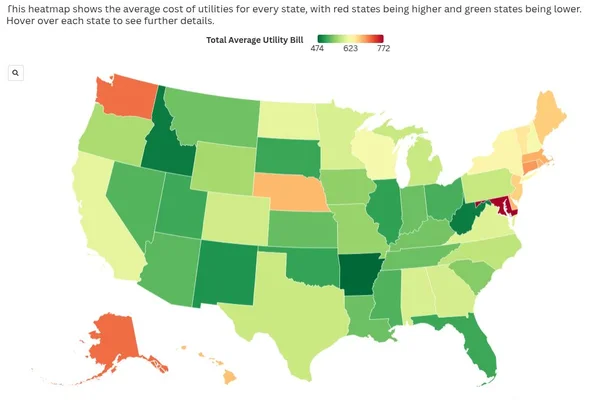
Regional patterns stand out here. States in the Northeast and Pacific Northwest tend to see higher bills, often due to older housing and higher energy demand. Many southern and midwestern states, on the other hand, enjoy lower average costs thanks to cheaper energy and shorter heating seasons.

In the interactive map below, you’ll be able to see how your own state compares. The map shows both the average monthly utility bill and what share of a typical household’s income goes toward those costs. It’s a quick way to spot where utilities are most affordable, and where they might stretch your budget a bit more. A heat map of the United States showing the average cost of monthly utilities in every state. Maryland has the highest average monthly cost of utilities at $772 while Arkansas has the lowest at $474

How to Use This Data

Think of this data as a way to plan smarter. It shows what people actually pay each month for electricity, water, gas, internet, and trash in every state. You can use it to guess what your own bills might look like once you move, or to see how much prices change from place to place. It also shows what share of income goes toward utilities, which helps you see how far your money might stretch. If you’re building a moving budget, this is where to start.

Why Understanding the Cost of Utilities Matters for Moving

About a quarter of Americans don’t use a monthly budget, according to a 2023 NerdWallet poll shared by Fortune. That means millions of people go into big financial decisions, like moving, without a clear sense of what their bills will look like each month.

When you move, especially if it’s your first time living on your own, a budget can make the difference between feeling settled and feeling stretched. Utility bills often change more than people expect, even on a short-distance move. Different cities and states have their own rates for electricity, water, internet, and trash service, so it’s worth researching ahead of time. For more guidance, see our tips on how to move on a budget.

Budgeting for Utilities in 2026

A close-up of an electric meter on the side of a house showing utility usage

Creating a moving budget doesn’t start and end with the cost of boxes or the price of your movers. It’s also about what happens once you’ve unpacked, and the bills start showing up. Utilities are one of the easiest things to overlook, but they can make a big difference in whether your monthly budget feels comfortable or tight.

Start by looking at what you spend now. Write down your rent or mortgage, insurance, and the average you pay each month for utilities. Then, use the numbers in this article to estimate what those same bills might look like in your new state or city. If your new place is larger, older, or has electric heat instead of gas, your monthly total may go up. If it’s smaller or more efficient, you might even save.

How to make a utility budget

  • Compare your fixed expenses against your income: A simple way to check your math is to make sure your fixed expenses, such as housing, utilities, and transportation, don’t eat up more than about half your take-home pay.
  • Set aside money for lifestyle needs: From there, set aside money for food, savings, and the small things that make a new place feel like home.
  • Factor in house size vs. apartment living: Remember that living in a house typically costs significantly more than an apartment.

If you’re settling into your first home, our First-Time Homeowners Moving Survival Guide covers what to expect once you’re in, from unpacking to getting those first utility bills squared away. And if you’re headed to an apartment, check out these tips on moving to a new apartment for ideas to keep things organized from day one.

“The average cost of utilities per month in the United States is about $564 in 2026…However, utility costs change depending on where you live, how big your home is, and what kind of climate you’re in.”

Building this plan before your move helps you know for certain what you can afford, where to cut back if needed, and how to plan for seasonal spikes in heating or cooling costs. And when you track those details alongside your moving costs, you get a clear picture of your finances from start to finish. That’s exactly what HireAHelper is here to help with — making every step of your move, including the financial side, a little easier to manage.

Why Trust HireAHelper

HireAHelper has helped people plan and complete more than 1,000,000 moves across the country, connecting them with reliable moving labor that fits their budget. Our platform was built to make moving easier, with transparent pricing and trusted pros rated an average of 4.8 out of 5 stars by real customers. We care about what happens before, during, and after moving day, which is why we share guides like this one. Knowing what to expect from your utility costs and overall budget helps you settle in with fewer surprises and more confidence in your new home.

Methodology

To establish these benchmarks, we analyzed 2025 and 2026 household spending data across the United States. Our figures are derived from national census data, utility provider reports, and the HireAHelper internal moving cost index. We combined these sources to provide a weighted average that reflects typical household usage for electricity, gas, water, sewer, waste, and telecommunications.

U.S. Utility Costs 2026 FAQs

Recent Articles

penske vs uhaul

Penske Vs. U-Haul Comparison 2026

Costs & Saving

Overall, we recommend U-Haul for most DIY movers because it offers significantly more locations, better local move availability, and lower overall prices. However, Penske tends to have a newer fleet and better... Read More

A dumpster full of broken furniture and various other kinds of junk

How Much Does Junk Removal Cost?

Costs & Saving

Average junk removal costs range from $75 for a small load to $800 or more for a full truckload. That’s a big range, but prices vary so much because there are many factors that go into the price of junk removal,... Read More

a man stands in a room full of moving boxes while holding his smart phone

How Much Will Your Move Cost? Here’s How to Figure it Out

Costs & Saving

In 2025, you can expect to pay around $1,167.76 for a full-service local move (everything included) and $451.87 for labor only (loading and unloading help). Long-distance moving costs vary much more, and can cost... Read More

domestic abuse movers

These Moving Companies Move Domestic Abuse Victims for Free

Costs & Saving

If you’re trying to leave an abusive situation, moving safely and quickly can feel overwhelming—especially if money is tight. Some moving companies offer free or discounted services for survivors of domestic... Read More

a woman calculates the cost of a move with a calculator, surrounded by packed boxes

What’s the Cheapest Way To Move? A Guide for Thrifty Moving

Costs & Saving

Moving is a common part of life, whether you're seeking new opportunities, upsizing, downsizing, or just looking for a change. With the rise of remote work, there's even more flexibility with where to live. Recent... Read More

an array of cars and trucks are driving in both directions down a long highway in the middle of a very wooded area

Relocation Assistance Programs for Out-of-State Moves

Costs & Saving

Moving is stressful anyway, but even moreso when you are facing a tight timeline, fleeing abuse, or in financial hardship. If you need help moving out of state, your absolute best first step is to dial 211 to... Read More