Queen Mattress Moving Challenges (And How to Handle Them)
The hard part often starts once you add stairs, corners, or a solo carry. Safe handling comes down to a few basics: protect the mattress first, clear the route, and keep the weight supported the whole way.
Moving a Mattress by Yourself
Queen mattresses weigh about 60 to 120 pounds, and that bulk can wear you out faster than you'd think. If you have to go it alone, start with a mattress bag that has handles, clear the path before you lift, and carry the mattress on its side so you can work through doorways and tight hallways with more control. Memory foam may give a little, but innerspring and hybrid mattresses hold up better when you keep them flat and well-supported during the move.
Transporting a Mattress on the Stairs
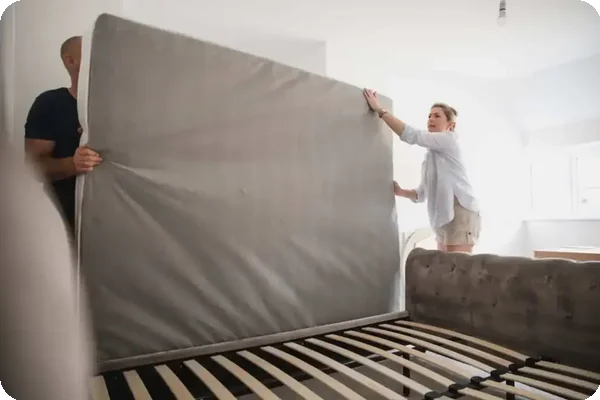
If you're moving a queen mattress on the stairs, having at least 2 people there makes the job much safer. Get your measurements first, then keep the mattress upright so it takes up less room on the staircase. Going upstairs calls for short lifts and clear communication, while going downstairs takes even more control because gravity is working against you.
Take it one step at a time, pause to reset your grip, and change the angle when a turn gets tight. Our guide on what to do if furniture won't fit down the stairs can help with tougher stair setups.
Moving a Mattress Without a Truck
It's possible to move a mattress without a truck, but you'll need to use a vehicle that supports it properly. A pickup, cargo van, moving container, or trailer can all work better than trying to force a mattress into a car that's too small.
The key is full support, a tight wrap, and straps that keep the mattress from shifting while you drive. If you already have transportation lined up, labor-only movers can be a smart middle ground. They'll help carry the mattress down the stairs or through tight corners while you handle the rest.
Maneuvering a Mattress Around Tight Corners
You can get a mattress around a tight corner, but remember that the angle matters more than force. Stand the mattress on its side, then pivot it slowly instead of trying to push it straight through. Tight corners usually go better when you stop, reset your grip, and change the angle a little at a time.
Keep in mind, a mattress bag helps protect the fabric while you turn through hallways, stair landings, and narrow door frames. If the path gets tricky, patience does a lot more than muscle.
Transporting a Mattress in the Rain
Moisture can sink into the fabric and inner layers of mattresses, leading to stains, strange odors, mold, mildew, and a shorter lifespan. A mattress bag is your first line of defense, and plastic wrap can add another layer, though plastic wrap alone is not waterproof. Keep the mattress covered, move it quickly, and dry it fully at the other end before you put sheets back on.
Tying a Mattress on Top of a Car
You can tie a mattress on top of a car, but it should be a backup plan rather than your first choice. Wind can catch the mattress and shift the load while you're driving. If you don't have a better option, use strong straps, secure the load front to back and side to side, and keep the drive short and slow. A pickup, cargo van, or moving truck is usually the safer call when you have one available.

.png&w=96&q=75)

 Karen BodkinAug 28, 2026